Search This Blog

Friday, February 3, 2023

2022 FIFA World Cup in Qatar: A Sweet and Sour Fan Experience


February 3, 2023

Last November and December, the world sat transfixed as one of soccer's greatest stars, Lionel Messi, led his native Argentina to their elusive third world title in the tiny country of Qatar.  It was a controversial moment in December of 2010 when FIFA awarded a country with no soccer history or culture, the pinnacle of the sport's international tournaments.  It turned out to be a World Cup with many underlying negative storylines (its stance on LGBTQ issues, international workers, and women's rights). Those issues still did not overshadow the incredible games that progressed over the monthlong tournament.   

______________________________

The 2022 FIFA World Cup was one of the most memorable football tournaments in recent memory, possibly ever.  The important issues being discussed before the quadrennial event were the dubious process and methods that awarded the spectacle to a tiny country with no real soccer culture or commercial appeal.  What did entice voting members of FIFA's Executive Committee was the rumored, large sums of money that were given to those who voted favorably for the gulf state. I remember reading countless online publications and watching ESPN once Qatar was announced as the winner over the heavy favorite, the United States.  There was palpable shock and surprise, and shortly after, many media pundits and sports anchors believed there was some unfortunate, backroom horse-trading that transferred votes to the gulf state.  Additionally, the specter of imported workers from poor regions of Asia, Africa, and India building these gigantic stadiums, which resulted in an unconfirmed (official) number of deaths, received a small amount of negative publicity. It was talked about relatively little in Western media (including during the World Cup by the late soccer writer, Grant Wahl), but nothing was really proposed to protect workers from these practices leading up to the World Cup.

The games themselves were full of drama, with doses of "shock and awe", and had many surprising teams pull off victories for their passionate supporters, some of whom traveled in large numbers with them.  In the group stage, viewers saw the eventual winner Argentina lose to Saudi Arabia, generally a minnow in international soccer. Japan surprisingly defeated the 4-time winner, and global powerhouse Germany along with European power Spain, which allowed them to win the tough Group E and eliminate Germany from the knock-out rounds.  Germany has not made it out of a World Cup group since 2014,  the year in which they last won it all.  That is a mind-blowing statistic for a country that produces stellar players and has a reputation for being tough opponents to beat consistently.

Another country that captured the world's attention and support was Morocco.  The north African country has never made any waves in tournaments they have played, but in Qatar, they beat Belgium (2-0), Canada (2-1), and tied 2018 Runner-Up Croatia (0-0).  They beat Group E runner-up Spain in the Round of 16 (3-0) and defeated Cristiano Ronaldo in the Quarterfinals to make a historic statement by making the Semifinals, the first time an African team has made it.  They won the hearts of many soccer fans, but their journey to mythical status was cut short by the defending World Champions, France.  They would eventually lose the 3rd place game for an impressive fourth-place finish.  They are the new bar for African teams when they participate in this tournament now.

After the failure of not qualifying for the 2018 tournament, the United States Men's National Team (USMNT) made it to Qatar with a young, talented squad that was a little "wet behind the ears." Most soccer analysts believed the U.S. team would stand a good chance of getting out of the group, but advance no farther than the Round of 16, which is what happened when the United States ran into a solid Netherlands team.  I for one had hoped the men would put up a good fight, and they did in spurts throughout the game, but three fatal failures during the run of play and on defensive lapses sealed their defeat.  Most USMNT fans feel the results were acceptable of the tournament but now hope that with the experience on the world stage behind them, the team can do great things in front of their home fans when this great tournament comes to Canada, Mexico, and the United States.  I would love for them to make a final (and even win!) on home soil, but I am just hoping for a good show and a respectable run.

The 2022 FIFA World Cup champion, Argentina, even though it was one of the favorites, did not start the tournament well.  After their defeat to Saudi Arabia, their next game against Mexico would be pivotal; this would tell soccer fans whether they had the horses to get back on track.  While Mexico provided a good test, Argentina passed with flying colors and would win their group. In the Round of 16, they held on against a tough Australia squad (who nearly equalized in injury time), 2-1.  Next up was the Netherlands in the Quarterfinals, which was a dark horse team to go far in the tournament. It was one of the best games to date.  The Dutch went down 1-0, then 2-1 until Wout Weghorst tied the game in injury time.  It was one of the most surreal endings to a soccer game I have seen in many years (outside of LAFC tying the Philadephia Union in the Major League Soccer [MLS] Final the other time). Neither team scored in Extra Time, and the game was decided in penalties, which the Argentinians won in dramatic fashion. Leo Messi and his fellow Abliceleste (White and Sky Blue) easily handled Croatia in the Semi-finals.  

The final, Argentina vs. France, matched countries that have previously won the World Cup twice, and the winner would win their coveted third star above their crest.  In the first half, Argentina set the pace, controlling possession, and keeping French striker Kylian Mbappe at bay, for a comfortable 2-0 lead at halftime.  The second half saw France exert itself, using two penalties and a beautiful third strike by Mbappe to send the game into Extra Time and giving him a hat trick in a final, something that has not been done in 60 years. This classic would go to penalties, which can go either way, but this time, whether it be destiny or luck, Argentina won. It gave Argentinians something to celebrate, lifted a huge burden off of Leonel Messi, and put him in rarified air with another Argentine legend, Diego Maradona.  It was a fitting end to this great tournament.

Now that the tournament is over, there are things that FIFA can do to ensure that future World Cups do not have any negative stigmas surrounding the build-up before the first game is kicked off. The Executive Committee should enshrine in their rules that any host country, or countries, must pass certain criteria and benchmarks that promote equal rights for all: LGBTQ and especially women. Those who build the infrastructure (stadiums, roadways, FanFest locations, etc.) must have protections so that their welfare is paramount and will not be abused during the lead-up to the tournament.  No country bidding to host the FIFA World Cup that excludes ethnic or religious minorities, people who have been historically abused or mistreated, or do not have equal rights, should be allowed to win hosting rights at all. This must be strictly enforced, no matter how much money a bid amount is thrown at FIFA's Executive Committee (I am looking at you Qatar).  This is known as "sport washing," where a country with a dubious track record of protecting human rights and authoritarianism is allowed to host global events (World Cup, Olympics, F1 racing) and launders their sins through these sporting spectacles, and buys or bullies for positive press during a monthlong tournament, like the World Cup.  Qatar and China are two countries that exhibit this idea. FIFA should be stringent in the guidelines that Executive Committee voting members must adhere to in order to vote for a country's winning bid.

The United States, which is co-hosting the 2026 FIFA World Cup with Canada and Mexico, has some of the best stadiums in the world, and along with a strong currency and economy, it should break all kinds of attendance, viewership and attendance records (that it held since the 1994 World Cup in the United States).  The U.S. Men's National Team and the United States Soccer Federation (USSF) need to get their house in order before that event arrives in America, however. Recently, it was discovered that there was tension between two families within the U.S. soccer community, those of current coach Greg Berhalter and Claudio Reyna, both of whom played soccer together for years: club, college, MLS, and the USMNT. Since Mr. Berhalter did not play Gio Reyno (son of Claudio) regularly during the recent World Cup, Mr. Reyna's wife told senior officials at the USSF that he had assaulted his wife nearly two decades ago.  This purported blackmail, so that Greg Berhalter is punished for not playing their son and not allowed to return to coaching the national team, has been a serious black eye for the men's program.  

The federation needs to remove all parties who are involved and associated with any previous misdeeds and not allow them to feature prominently for either MLS or the USSF.  The USSF needs to find a coach with a solid track record of taking a group of players and having them play above their weight, to coach the latest generation which has proved it has more talent than the teams of the past.  Hope springs eternal, and for once in 2026, it may meet expectations for U.S. men's national team fans.

Saturday, December 24, 2022

What happened to the "Red Tsunami?" The Democrats bucked past precedent for parties in power.


December 24, 2022

The recent runoff decision for the United States Senate seat in Georgia, between incumbent Rafael Warnock and former NFL player Herschel Walker, completed the last of the elections for the 2022 Midterms.  Senator Warnock was re-elected by a razor-thin margin. It put a definitive exclamation point on results that upended conventional wisdom. Usually, the incumbent President's party loses seats during their first election cycle. This has been the norm for decades.  How did Democrats prevail despite the political winds heavily favoring the Republican party?

________________________________

The 2022 Midterm elections were shaping up to be a celebratory year for the GOP in Congress, with an uninspiring Democratic President, inflation, fluctuating oil prices on the open market, an embarrassing withdrawal of American forces from Afghanistan, and Americans unhappy with the direction of the country overall. Things were looking up for the Republicans.  How did the Democrats lose only the House (barely) and hold onto their Senate majority with an equally slight advantage despite most people believing it was going to be a good night for their opposition?

I think the recent Supreme Court ruling overturning Roe v. Wade played a very large part in public sentiment, despite conservatives believing that a large percentage of Americans agreed with that ruling. I am of the belief that while some women would never terminate their own pregnancy under any circumstances, a good number of others would prefer it was an option available to them if the need arose.  A large reason for success during non-presidential year elections is voter turnout, and voters turn out if they are motivated to do so.  While overturning abortion may have been on the wish list for Republican voters for decades, it possibly proved pivotal in turning out Democratic voters.

Another factor in the Democrats' favor was poor candidate selection by the Republican National Committee (RNC) in the Georgia senate race between Herschel Walker and incumbent Rafael Warnock.  Mr. Walker had a myriad of personal issues (abortions for his past girlfriends, his openness about his multiple personalities, not believing in evolution, and poor debate performance) and it did not instill confidence in Republicans in that state that he could win.  Doctor Mehmet Oz in Pennsylvania was another problem candidate.  Despite his high-profile name recognition, his personal wealth, his relationship with Oprah (who endorsed his opponent), and fundraising prowess, he failed to beat his Democratic opponent, John Fetterman, who suffered a stroke before the election and embarrassed himself during their one and only debate.  The Fetterman campaign was smart in scheduling the debate a month after early voting began, thereby reducing the chances for Dr. Oz to change the minds of undecided voters.

The Republicans did see the presumptive frontrunner for the Republican nomination for President in 2024, Ron DeSantis get re-elected easily in Florida.  Additionally, the Democrats saw some of their candidates win high-profile statewide executive positions (Gavin Newsom in California, Gretchen Witmer in Michigan, Katie Hobbs in Arizona), and the party was able to prevent Republicans win a large number of governorships.  In some of those races (Witmer and Hobbs), the Republican candidates were closing the polling and enthusiasm gaps, and it appeared that the GOP would gain those seats, but in the end, the Democrats eked out those wins on election night.  

While the 2022 Midterms were not a total disaster for the Republicans, the party's leadership was clearly not happy with the final results.   The Democrats, however, didn't exhibit any tactical mastery in strategy nor did the outcome reinforce President Biden's popularity.  A lot of it came down to Republican mistakes and poor candidate choices as previously stated.  Additionally, the public embrace of former President Donald Trump (Kari Lake in Arizona), and other candidates did not have the draw or appeal that many Trump supporters thought it would.  I think the American people are tired of constant claims of "election fraud," or "re-instating" candidates who lost.  I believe that Trump's time as the power broker in the Republican party is coming to an end, and the sooner the GOP realizes this, the party can move on and find new candidates to carry the torch for their political platform.   

The 2022 Midterms were really a message to the Republican party, in that voters were tired of the antics of Donald Trump, and the drama he brings with the national media, including those who wish to monetize their animosity towards him.  The American people want their government to be competent and improve and protect the quality of life for their families.  

Conservative candidates and incumbents didn't provide any solutions for current issues either, such as illegal border crossings, and how to stem that flow of illegal migrants crossing into the United States in large numbers.  Nor was any serious thought given, with policy initiatives, to improving the economy or giving Americans hope for the future.  It's no wonder the party was not able to make any inroads with disaffected voters or gain new voters for the party.  In order to win, you have to give people something to vote for, rather than vote against a President that half the country doesn't dislike (even though his policies do not seem to win over too many people).  Candidate selection is part of it, and the other key element is proving solutions that Americans can get behind.  I believe the GOP "phoned in" their strategy for victory, which simply means they thought supportive polling and a political environment for the taking would take care of itself.  Hollow slogans do not push political parties over the finish line. Rather, it is fulfilling promises with hard choices that warrant victory.

Will the Republican party learn from the lessons of the 2022 Midterms? Will they move on from the Donald Trump era and coalesce behind a new face of the party?  Will they be better at choosing good candidates and providing them with the tools to be successful?  Time will tell what the party does to prepare for the pivotal races in two years.  The 2024 election will be a monumental election, and one whose results with have consequences for many, many years.  If the GOP is smart they will take stock of where they went wrong, admit their costly errors and come back a better party.  For if they do not, the shock of losing winnable races will culminate in losing the party's most coveted race in 2024, the White House.

Tuesday, November 8, 2022

Immigation Wars come to Martha's Vineyard


November 5, 2022


Last month Florida governor Ron DeSantis transported immigrants who entered the United States illegally and were sent to his state by the federal government, to Martha's Vineyard, a wealthy enclave where elites have weekend or summer homes, in the eastern part of Massachusetts.  Was it a brilliant move, or a shameless attempt to win points with supporters, at the expense of migrants and the immigration debate?

_________________________

The immigration war between the two rival Republican and Democrat parties and the activists for and against this contentious issue was given a new twist in this conflict. Governor DeSantis of Florida sent 50 migrants, mostly Venezuelan citizens, to the very wealthy and exclusive community in Massachusetts, Martha's Vineyard. It received a lot of coverage on national networks, especially conservative outlets like Fox News, and has drawn attention again to the impasse of what the country should do for its immigration policy.

Whatever your opinion is of the plight of these illegal immigrants, and their relationship to our broken immigration system overall, they are sadly being used as pawns between these political parties and their donors for political gain. This is unacceptable.  The United States has a myriad of problems, and finding common ground for solving this contentious issue should be a priority.

There is urgency for a resolution to this challenging issue. It is not productive for both political parties to go back and forth, placing blame on the other without trying to find a more pragmatic and humane treatment of these people. This vacillation, the lack of initiative, non-cooperation, and deferring legislation is causing serious conflict between various citizens, organized groups, and large companies. It has generated anger and conflict between American citizens who want to limit immigration rules and activist groups that argue on behalf of their desire to enter by any means necessary. It will generate vigilantism amongst those worried about the "invasion" from our southern border, where over 2 million have come across during the first two years of the Biden Administration, based on reporting by national media outlets.  Under the Trump administration, curbing illegal immigration was not successful, but inexplicably it did reduce legal immigration, according to the CATO Institute.  It seems neither party has any real or substantive record of dealing with this problem and seems to paradoxically reduce the right kind of immigration in favor of uncontrolled immigration.

Activists seem to bypass and ignore government regulations and laws already on the books and try to change those laws to bring in more illegal immigrants from Mexico and Central America, in my opinion. Ignoring this aspect of the immigration issue is not healthy, or useful. It is essentially "gaslighting" (pretending a viewpoint does not exist) those in favor of sound immigration policy,  and could lead to great discord and violence if there is no resolution.  That is why hammering out a pragmatic official U.S. policy is a priority that will bring down the temperature of disagreement for all involved. More importantly, it brings about fairness for those wishing to emigrate to the United States while protecting their dignity.

Why does this problem persist with no reasonable resolution? My belief is that donors to both parties enjoy low-cost labor that does not require benefits and livable wages that rise with the cost of inflation.  This results in larger corporate profits and does not incentivize the Democrats or Republicans to work out a solution.  Listening to podcasts, national media, and reading online print publications, there is an argument made by conservatives that Democrats promote this policy because they want to provide benefits (social entitlements) to new immigrants and build relationships to promote party loyalty that produces predictable and dependable voters.  

This "demographics is destiny" idea does have weight, especially when you see it being promoted loosely on MSNBC and CNN by their media personalities and paid contributors. Fox News opposingly scares citizens into a fear of immigration from regions different from the early 20th century (people fleeing famine, war, and religious persecution in Europe) such as Central and Latin America, the African continent, India, and Asia.

What are we to do about immigration? Here are some of my suggestions:

  • "Remain in Mexico" policy: Any persons seeking entry into the United States from nations south of the U.S.- Mexico border should adhere to the "remain in Mexico" policy, which would require submitting a request to the U.S. government and stating the reason for being granted entry before entering the United States. Those immigrants would then have to wait in Mexico until their own case is ruled upon by a U.S. government asylum officer. This would alleviate any issues at the border and prevent any future humanitarian crises similar to what is happening now along sections of the U.S.-Mexico border. In countries where there is a stable democracy or human rights are upheld, perhaps those seeking immigration into the United States can get on a waitlist, or seek special consideration for an expedited process? Another solution would be to send any immigrant back to their country of origin to begin a legal process to emigrate to the United States. This places the onus on Mexico's government, which may lead to discouraging illegal entry from other Central and Latin American countries to that country as well.
  • Enforce indefinitely "Title 42:" The Department of Health & Human Services (HHS) instituted an emergency regulation, pertaining to health law in the country. During the Covid-19 pandemic, it was enacted to prohibit persons who may have a communicable disease from entering the country so they can be screened.  I think this should be applied to all persons who seek entry into the country so that in addition to requiring it of American citizens, new immigrants are held to the same standard. This can be done at a country of origin rather than at the United States border.
  • Give priorities to high-skilled workers: Continued importance should be given to any persons seeking entry into the United States who have a skill that can be useful and productive to the communities where they will live (IT professionals, physicians, engineers, lawyers, etc.) as well as serving the American economy. Anyone who can improve their communities and bring an important, necessary skill should be streamlined against those who have no persecution as their primary reason and have lower skills. This idea should be incorporated into any new and updated immigration policy. Seeking a better life for the less fortunate is fine, but there needs to be a limit on how many of those qualify under that standard so the system of the social safety net is not excessively burdened.
  • Updated Immigration Laws: Republicans and Democrats in Congress must work cooperatively for a decisive and fair immigration law that the country can use as a uniform policy, where there are definitive directives and U.S. codes that federal agencies and state governments must strictly adhere to. Anything less will incite anger and conflict.  Rules, such as "Remain in Mexico," and Title 42, must be incorporated into any new policy for it to be humane and effective. Taxpayers will likely agree to fund if this legislation meets their goals.
  • Find where taxpayer money can be used for greater effect: Most immigrants who come, both legally and illegally, from Central and South America usually have family or friends already here who can provide them with some assistance (housing, food, resources, etc). I don't think housing is the real problem.  The crux is where to best spend taxpayer funds, and I think that is for healthcare, education, and job skills training. Perhaps states or municipalities can provide better data on where tax money can better be used to help immigrants assimilate and become productive in American society.
  • "Encourage" nonprofits who support illegal immigration to help finance costs through taxation: One of the many problems with illegal immigration is the massive financial costs that are paid with taxpayer funds.  Since these activist groups are in favor of this type of immigration, perhaps they can be taxed and those funds used to help provide shelter, food, and any other forms of assistance to better assimilate into our communities?

The general public must push members of Congress to work on any new bills since corporate interests and activists for undocumented immigrants will be against any proposed immigration law.  The American people need to be aggressive in reminding their representatives that fixing the corrupt and broken immigration system is of enormous importance, and needs to be done in the near future.  The sad part is that for either political party, anything that is done is usually based on a two-year political cycle and whether it will affect individuals, their professional, and the party's fortunes at the ballot box, rather than what will protect our border and improve immigration for all.  Pragmatism and common sense are never motivators for progress in the halls of Congress, and that needs to change.

Tuesday, September 6, 2022

What is the real purpose of the January 6th Committee?


September 6, 2022


Over the last few months, Americans have been given the opportunity to witness the hearings of the Select Committee to Investigate the January 6th Attack on the United States Capitol. Various witnesses have been presented to a committee hand-picked by Speaker Nancy Pelosi, with only two Republicans (Liz Cheney and Adam Kinzinger), both of whom have been ostracized by the GOP caucus for their participation.  In an angry and divided country, where Republicans and Democrats both trade using the power of the government for their own ends, what is the ultimate purpose of the committee itself?

______________________________

According to various media personality opinions, the committee's main goal is to bring justice to those who unlawfully entered the United States Capitol on January 6th when the 2020 election results were being certified by Congress.  It was truly a shameful day in American history, and those who were trespassing, and causing property damage while the Electoral College results were approved should be prosecuted under federal law. I fully agree with that.

However, the committee's goal does not appear to seek prosecution of those who committed any crimes.  The members do not seem to investigate the root causes of why Trump Supporters decided to storm the U.S. Capitol and voice their anger and opposition to certifying results. For the 9/11 Congressional Commission, which sought to make public errors on the part of the government, the foreign policy establishment, and domestic security entities, leading up to that fateful day in 2001, this January 6th committee isn't by comparison interested in finding the primary motive for what transpired that day. It appears that the goal of this committee does not seek out answers so this episode never happens again. I don't see any effort to put out any simmering fires of voter resentment, or mistrust in how we conduct fair elections since that day.  The committee must do more in their transparency, to strive to make assurances to a divided electorate about why our elections have become so violent in their opposition to either dominant political party, and what things can be done to lower the temperature and enforce civility for future election outcomes.  That is the most important message and purpose in my view.  

The January 6th Committee has called several witnesses, some of whom have worked in the White House at different levels of seniority, (including Mark Meadows and aide Cassidy Hutchison), and journalists embedded with the groups in the crowd (Oath Keepers, Proud Boys), election night workers, former Department of Justice (DOJ) officials, all to gather what took place in the months, weeks and days leading up to election night.  Some of the testimony that I have watched or listened to, and questions from the committee members themselves, seem to paint or imply a direct line to one person, and one person only, former President Donald Trump.  The committee doesn't seem to want to find out why people stormed the Capitol but instead wants to gather evidence to directly blame Mr. Trump.  To be fair, former President Trump played a significant role in creating the tinder for this whole affair when he made ludicrous statements that the "election was rigged," and that his rightful victory was taken from him. Is he the sole cause or the largest, most visible participant in the immense damage done to American democracy and a politically convenient figure to target?

One complaint from conservatives and Republicans is that there was no cross-examining of any of the witnesses. Since this is not a trial per se, I don't think there is any reason for cross-examination.  Witnesses provided their testimony and then were excused.  People watching the hearings may assume what happened, but since it is a Congressional, and not a civil matter, there is no requirement that any witness has their testimony challenged. Since the committee is largely skewed toward Democrats, with only two Republicans represented in Liz Cheney and Adam Kinzinger, the GOP complaints seem valid.

What is the actual purpose of these hearings?  Will there be criminal charges levied against Mr. Trump by the DOJ?  Was the committee trying to tie some sort of Constitutional technicality on Mr. Trump to what happened on January 6th? I believe there is language in the United States Constitution that implies disqualification for anyone from running for federal office that leads to any sort of "insurrection" against the United States government (14th Amendment).  Many political pundits on television seem to tie the words "Trump" and "insurrection" together at every turn. I believe this repetition is geared toward creating a self-fulfilling prophecy and will eventually come to fruition, either through evidence unearthed through these hearings, or other factors, such as the DOJ seeking certain "classified" documents from Mr. Trump. It is to eventually convince Americans that there was something truly nefarious about his actions, and he imperiled democracy, with the smallest amount of implication and inference.

If there is evidence proving former President Trump's guilt, then let him receive justice. However, if after time, it is obvious that this is shown to be an exercise to damage or remove a prospective challenger with a real chance of defeating President Biden in 2024, then it will only further enrage his supporters and make it even harder to have impartial election results. Additionally, it could cost Mr. Biden any moral sympathy and support from independent voters.  Attorney General Merrick Garland and the DOJ must provide sound reasoning (as well as evidence) as to why they are using these drastic methods.  

In light of the recent developments where the Federal Bureau of Investigation (FBI) raided former President Trump's Florida residence at Mar-a-Lago, things certainly have become more interesting. This event has raised the stakes, and according to national media and many online publications seem to believe that there were secret nuclear documents or sharing of "classified documents," which, if true, is most damaging to the case against Mr. Trump. The Affidavit that the DOJ used to get a warrant was released on Friday, August 26th.  Most of the text was redacted, but from what remained, there did not appear to be any incriminating behavior from former President Trump.  That could change if the redacted words are available for public viewing, but for now, the DOJ needs to make a concerted effort to show the country that there is a serious case to charge the former President.

So far, the January 6th Committee has done nothing to show who was actually behind the riot at the Capitol or provided any evidence as to what was the primary cause to get so many people to charge inside the building illegally.  I find what the committee has done so far as mostly window dressing.  For the country to approve charging a former President with a crime, the evidence must be damning, overwhelming, unequivocal, and most importantly, not for political gain. Anything less will not suffice and could damage Mr. Biden's chance for re-election.  Most importantly, the DOJ, Merrick Garland, and the White House may have charted a path that will take generations for the country to recover from, or not at all.


Wednesday, August 3, 2022

Will "Wokeness" cause division and conflict in American society?


July 22, 2022


During the period before and during the civil rights era in America, the phrase "stay woke" was to instill in its supporters a commandment to remain vigilant and not lose sight of the prize, racial and gender equality.  Additionally, it was softly spoken so as to be aware of the deception and malice by anyone toward African-Americans in general. 

Today, that has morphed into an extreme and fanatical version of political correctness. It is an over-emphasis on empathy and understanding of those marginalized communities (LGBTQIA, African-Americans, Native Americans, and others who are on the periphery of American consciousness) which has turned into a type of militant, conformist coercion from those who are the "enemy."  In many cases, the anger is directed at white people and men in particular.  This era of "wokeness" is a danger to our country.

_________________________________

Over the last few years, the term "woke" has come into formal and informal discourse amongst Americans.  The term has existed but has not been used regularly, even in the mainstream legacy media, until recently.  From what I had read, the term was spoken about by African-Americans during the fight for racial equality, and to protect future generations about the dangers of deception from outside the community.  I believe over decades the term slowly started to matriculate into the consciousness of the university system in America as well, which is the fuel for today's incarnation.

However, it wasn't until the shooting death of Michael Brown by a Ferguson (Missouri) police officer in 2014 that brought the term into the national discourse of race relations. At least, that is according to an October 2020 Vox article by writer Aja Romano. In it, she detailed how the term was used by activists to warn black people to be prepared for police violence toward African-Americans by mostly white police officers. Ms. Romano states that the term "woke" was then taken over as the main political ideology of the progressive Left, but also used as a negative connotation by the Right.  Her article goes on to imply that "wokeism" has been incorporated into progressive social justice platforms and the introduction of critical race theory into the public consciousness. This has been steadily building over time.

I believe what pushed this ideology into its current aggressive, coercive militarism was the collision of multiple political hurricanes in the form of the Trump presidency, a once-in-a-century pandemic, Americans losing their jobs and financial security, and a need for an outlet after almost two years of social isolation.  The explosive charge for all of this was the video of George Floyd being killed under police custody for a drug-related incident.  

While I feel there was a genuine sense of outrage at how Mr. Floyd was treated by the Minneapolis Police Department, and Americans generally wanted to show their displeasure against what happened, the rioting and civil unrest that followed through to Election Day in November 2020 was encouraged by hidden, monied forces in our political donor class. There were images caught on television that showed rioters leaving bags filled with bricks for other miscreants, which were intended to be used as projectiles against police in cities where riots were happening.  I remember seeing news reports of U-haul truck rentals that had shields and other weapons that were purportedly paid in cash intending for a battle by the protesters.  In my opinion, the national mood was turned into an opportunity for political gain by the Democrats against an unpopular President Trump. I feel the media took advantage of the tragedy to further inflame public sentiment against the President when in reality the political pundit class should have initiated a national dialogue on better policing, instead of pushing "defund the police" narratives.  Alas, an opportunity was overlooked.

Wokeism has led to the rise in "cancel culture," in which ordinary Americans who shared unpopular or uncouth opinions, are summarily fired from their places of work. Potential university students who were accepted at their college of choice were told their acceptances would be revoked due to their right-leaning, or unpopular, non-conforming positions.  Additionally, college professors who refused to grade students of color on lenient grading curves were chastised by students and some of their colleagues.  Some have even left the profession entirely rather than go against the idea of being able to argue their positions with students and being forced to bend the knee to the mob without any sort of protection.  Even protection in the form of tenure is being used as a carrot for coerced acceptance of woke positions.

Critical Race Theory posits that through all aspects of American life, there exists a historic systemic racial oppression by white people, especially ingrained in fields of medicine, law, engineering, and other professions especially.  The belief is that in order to dismantle these supposed obstacles to racial equality, certain racial groups (Black, Indigenous, and other People of Color-BIPOC) must be given preference, or outright bias in terms of promotion, hiring, and other support in their careers, whether they be in Fortune 500 companies and government service, including the military.  While I do think certain measures can be taken to ensure more people of color, women, and members of the LGBTQIA are given opportunities for career advancement and acceptance into prestigious universities and companies, I do not think merit should be removed entirely.  Talent, hard work, drive, and persistence should still be the characteristics that allow people to succeed in this country.  To remove merit would pose serious damage to how we as a country view ourselves affecting our prowess and would place an undue burden and resentment, on those who were given preferential treatment.  Race and gender should be considered as a tie-breaker if you will when there are many qualified candidates for career advancement,  but they should never be the primary vehicle to reward and promote talent.

Finally, wokeism has led to a trend called Environmental, Social, and Governance (ESG) criteria, which are ideas and value systems that evolved from wokeness into a set of standards that companies use for their internal policies (pay structure, equal pay, relationships with suppliers, partners, etc), their business model (how they do business, mission statement), and safeguarding the environment against climate change.  It works in conjunction with ideas similar to "diversity, equity, and inclusion," which are race and gender metrics used to determine hiring, promotion, and retaining memberships in exclusive organizations. For example, Blackrock, the huge hedge fund, publicly said they will look into who they do their business with based on their ESG score, and whether race and gender barometers meet their acceptable threshold. Salesforce, a cloud computing company based in San Francisco, explained on 60 Minutes to explain the value of paying men and women the same.  These large companies are not charities or non-profits but rather, they are in the business of making large amounts of money.  I seriously doubt these practices will ever stop them from making money, and they certainly will not lose money based on this principle.  While the public relations strategy hides the profit motives, for example, Blackrock buying large swaths of real estate in concentrated neighborhoods, thereby pricing out average Americans from home ownership is not discussed on a large scale.

Even the Department of Defense favors the woke movement, creating and promoting programs to "educate" members in the usage of personal pronouns, promoting the idea of systemic racial oppression, and creating tribalism within the ranks (literally and figuratively).  A large percentage of America's military personnel hails from the Midwest and the South, and as a result, the Pentagon announced recently that they will miss their recruiting targets for the 2022 calendar year. It's not hard to fathom out why people are reluctant to serve in a military that promotes this nonsense which disregards that their lives have equal value.
 

After these tumultuous last two years, I see a backlash growing as a result of these shameful policies.  After comedian Dave Chappelle made a controversial comedy special on Netflix, protests within the company ensued to cancel his production.  Senior management sent a surprising company-wide letter informing those who were upset that creative people must be allowed to express their own ideas and thoughts, and if anyone was offended by that policy, should work elsewhere.  I was shocked when I read about the decision. Hollywood movies with an agenda to promote this idea did not seem to make money, and some were downright failures (Lightyear, from Disney's Pixar Studios, for example). Despite Netflix's brave stand, the company released data that showed the company had lost one million subscribers (although that was lower than the projected two million subscribers).  Time will tell if that pushback grows into an unstoppable force or retreats.

Wokeism is not a sudden sensation but rather, built up slowly over many decades by proponents and activists but exploded into the country's consciousness with the trifecta of Covid-19 (with isolation and depression and anger that followed), loss of jobs, and financial security due to the pandemic, and the trauma of Democrats view of the Trump presidency.  It is now fully ensconced in all aspects of our society.    

Removing deleterious aspects of wokeism is not a quick fix but must be slowly removed one day at a time and will take years, if not decades.  If the Republicans take control of both houses of Congress, they must work with President Biden to promote more opportunities for Americans, while making merit, hard work, and persistence the cornerstone for individual success.  The Biden administration or a future Republican administration must reassess Critical Race Theory, stop demonizing Americans for their personal views or their race, and return the military to an elite fighting force that focuses on mission success.  

I would recommend including race and gender as tie-breaker when selecting candidates for promotion and hiring, but it should not replace a character, moral values, or those who are deserving based on impartial criteria.  If things don't change, wokeism will become something similar to theocracies or autocratic governments in other parts of the world.  This will involve a small, exclusive group of people who will benefit, live large and happy, and determine who is rewarded with success, while the vast majority of citizens spend their time fighting, spying, and arguing with each other. The quality of life will deteriorate and the American experiment and its Dream will end.  As a country, we Americans must fight to protect what made it great while trying to constantly evolve for the better.  Wokeism is not the answer, but a blueprint for failure and must be avoided at all costs.


Sunday, July 10, 2022

Roe v Wade Supreme Court Ruling: Why It Was Not a Shock


July 10, 2022


On June 24th, the Supreme Court of the United States (SCOTUS) voted to overturn the landmark 1973 Roe v Wade ruling, which protected a women's right to medical privacy, which included the ability to terminate her pregnancy.  Although shocking news, many Americans were aware this was likely to happen when someone associated with the court mysteriously, but purposely, leaked a draft of the majority opinion to a sympathetic news outlet.

_______________________________


For innumerable women across the political spectrum, this was a sacrosanct procedure.  For Republicans and other conservatives, this judicial ruling was the outcome of efforts stemming from the strategy for presidential candidates to nominate strong Constitutional judges to the senior bench. Overturning this precedent and law through a court case was paramount to their passion and beliefs as conservatives.  For Democrats and liberals, protecting this precedent was vital to win the voting preferences of women, who tend to be regular, loyal, and dependable voters for the party.

When President Obama was a candidate for president in 2008, during his campaign he promised, that as one of his early endeavors, he would push through the Freedom of Choice Act, which "declares that it is the policy of the United States that every woman has the fundamental right to choose to bear a child; terminate a pregnancy prior to fetal viability or terminate a pregnancy after established viability when necessary to protect her life or health.  This Act prohibits a federal, state, or local government entity from denying or interfering with a woman's right to exercise such choices; or discriminating against the exercise of those rights in the regulation or provision of benefits facilities, services, or information" (Congressional Research Service).

After the recent ruling, many Democrats in Congress and their supporters want President Biden to "codify" abortion, which simply means to enshrine it into law or create a systemic federal code that protects women who choose to terminate a pregnancy. It would carry onward the language and spirit of the Freedom of Choice Act.  It is unsure at this time if Mr. Biden has the votes for this to happen.  Trying to do so before this year's midterms has high risk and reward for the Democrats at a time when their majorities in both chambers of Congress hang in the balance. In my opinion, party insiders and senior leadership feel that something needs to be done since women comprise an important demographic in the Democratic coalition, and not doing anything would jeopardize their valuable voting power.  On July 8th, President Biden signed an Executive Order which sought to protect access to abortion medication, and emergency contraception, protect patient privacy, launch public education efforts, provide legal advice pro bono, and security at facilities that provide those services (CNN.com).

Republicans felt vindicated and joyous after the ruling since it was a culmination of almost 50 years of dogged determination on their part to force Republican presidential candidates to nominate "contextual" Constitutional judges from the federal bench to the Supreme Court.  Conservative dogma belied that the 1973 ruling was not in accordance with any Constitutional protection and that it was a matter for states to determine this through their voters.  Their mission succeeded, although no one knows how this ruling will affect the political futures of Republicans and Democrats. I feel that while Republicans approve of the Supreme Court referring the matter to the states, their ultimate goal is to outlaw the procedure throughout the country.

Some members of the Senate Judiciary Committee (Joe Manchin of West Virginia and Susan Collins of Maine) felt publicly betrayed by recent Supreme Court appointees, nominated by President Trump (Judges Gorsuch and Kavanaugh), who stated during their confirmation hearings that Roe v Wade was an accepted precedent. Some, such as Representative Ocasio-Cortez, want to impeach those judges who went against what they said in their testimony, but this is a tenous idea.

Conservatives made the case that their opposition to abortion was the protection of human life and that babies and the unborn need advocacy for their "rights."  Democrats counter that if Republicans truly cared about children, they would support government services and programs for prenatal and postpartum care, childcare, maternity leave, and educational services through young adulthood to prevent unwanted pregnancies. Supporters of Democrats also point out that there is a lack of clarification (also from some corners of the GOP) of what happens when complications from pregnancy arise: such as an ectopic pregnancy (fertilized egg growing in the fallopian tube outside the uterus), or miscarriage, when terminations of pregnancy are necessary to preserve the health of the mother, would it violate the recent SCOTUS ruling?

Some conservative online platforms, such as the Dailywire.com, state that any medical procedure to protect the life of the mother for those procedures would not be classified as a violation of the overrule of Roe v Wade rule and provided proof that medical websites such as WedMD, Mayo Clinic, and Planned Parenthood do not classify those options as "abortion." Ideally, having Democratic and Republican parties work out agreed-upon language and for medical indications and procedures that are protected by law would be a good thing for the country and demonstrate insight and clarity on a passionate issue for many.

Ultimately the fight over abortion is really a conflict between "two Americas" that have been growing apart for at least a generation. There are opposing viewpoints that eschew compromise, and empathy with those who don't share their worldview.  For some Democrats and liberals, abortion is viewed as a desired option so as not to interrupt the younger generation's ambitions to achieve professions and careers.  I think if companies provided and protected maternity leave, it would alleviate fears that careers may be put on hold or ruined by having children. That is my opinion. 

Anything that infringes on that purpose, is deemed sexist or misogynist.  Conservatives and Republicans feel that abortion is a vile procedure that violates the sanctity of life, biblical orthodoxy where they believe our morals originate, and the U.S. Constitution. Conservatives believe that the Constitution does not provide any language protecting the termination of a pregnancy.  Additionally, in this endeavor, they oppose teaching of sex education, the promotion of condoms and other safe sex methods, and promoting of abstinence, an essentially ineffective and impractical alternative.  The issue of abortion is really a proxy war between two diametrically opposed and unrelenting national views, and there seems to be no going back.  One side will be victorious, one side will lose, and American will never be the same.

One hopes that a new generation of Americans will take both views and come up with a fair compromise.  Those states that allow abortion will be protected and anyone who travels from a state where abortion is prohibited is ensured a safe procedure and avoids criminality.  In return, there must be some consensus in terms of how many weeks in a pregnancy will qualify for the procedure. Preliminary polling data shows that a segment of Americans wants to protect the procedure, but restrict it to 15 weeks, which seems generally accepted at this time. For abortion advocates, there should be no limit.  I feel, however, that there must be a medical basis to avoid indiscriminate procedures and to ensure safety and compliance.

If compromise is not reached, then the abortion battles will be part of a long war (abortion, guns, peaceful transfer of power after elections, etc.) where Americans demonize each other over issues they do not want to compromise on, and which will lead to a further unraveling of the American ethos.  Absolutism is not achievable in the American experiment in democracy.  Finding realistic solutions may not make everyone happy, but gives some hope of progress toward reconciliation.  From a national viewpoint, utilizing effective methods to tackle complex problems in a collaborative effort is likely to lead to greater agreement and acceptance.  That is my hope.

Tuesday, June 14, 2022

Uvalde, Texas: Turning Point on America's Conversation About Guns?


June 14, 2022


On May 24, 2022, Salvador Ramos, an 18-year-old troubled teen, shot his grandmother,  crashed a family truck near a school, took a large cache of weapons, and killed 19 precious kids, and two heroic teachers in the third most deadly mass school shooting. Is now the turning point for a serious discussion between effective and pragmatic gun laws, while threading the needle of the 2nd Amendment to the United States Constitution?

___________________________________

With the images of the Sandy Hook Elementary school shooting in 2012 fading from memory, another horrible and tragic mass casualty event at an elementary school has brought the contentious gun debate into the American consciousness front and center again. This tragedy took place at Robb Elementary School in Uvalde, Texas.  These types of shootings happen in America with troublesome regularity. The sad part is that Americans have become numb and it doesn't shock our country anymore. Before Uvalde, the nation absorbed the shooting outside of Buffalo, New York at a supermarket patronized predominately by African-Americans, which killed 10 people. Will this shooting be the episode that forces entrenched members of Congress into a serious, bipartisan movement that brings about change?  If there is change, what does it look like?

The shooting in Uvalde, Texas was made all the more jarring after the initial shock wore off, because of intense scrutiny of how law enforcement officials behaved, and it was not good.  

It appeared that Mr. Ramos started shooting after he crashed the pick-up truck, across the street from a funeral home and when staff attempted to come to his aid, he opened fire on them with his AR-15.  One of the employees contacted 911 about an active shooter.  After that incident, Salvador Ramos found a way to enter the school through a malfunctioning door that would not close.  Eventually, he locked himself inside two-adjoining classrooms and proceeded to kill 19 students in those classrooms, along with their beloved teachers.

Texas Governor Greg Abbot, after initially praising law enforcement, was angry when the timeline was exposed since it appeared that local law enforcement, including the Uvalde Consolidated Independent School District (UCISD) police department, told the responding police officers to stand down once a perimeter was set-up.  The school district police chief, Pete Arredondo, who had tactical authority, believed the shooting had moved from an "active shooter" to a "barricaded suspect," and law enforcement officers did not breach the 4th-grade classrooms where the carnage took place until roughly 78 minutes later.  

Mr. Arredondo later stated through his attorney that he didn't bring his police radio with him so he could apparently use both hands for this weapon.  His actions will be continued to be scrutinized and hopefully, the truth will come out after a comprehensive investigation. It was gut-wrenching to hear that wounded students were trying to get the police to enter the classrooms as they were bleeding out but to no avail.  

One of the teachers, Arnulfo Reyes, who was part of the 18 people wounded heard his students pleading to get the police to enter the classroom, which never materialized, only to have the shooter come back and shoot additional students. Mr. Reyes said that law enforcement outside the classroom was trying to negotiate with the shooter that if he gave up and came out that he would not be hurt if he did that. Finally, a decision was made to engage Mr. Ramos.  Among the many branches of responding law enforcement to the crisis, the U.S. Border Patrol's tactical special response unit (BORTAC) decided on their own to enter the school grounds, locate the shooter and end his life.

The aftermath of this heartbreaking event brought intense scrutiny to how this tragedy was handled by local and state authorities.  Some questions to ponder:

1) Despite the overwhelming law enforcement response and numerical superiority over the lone gunman, why was there no serious attempt to locate the shooter, breach the classroom, and eliminate the threat in a shorter time frame?  

2) Why did Pete Arredondo arrive at the school and not use his police radio/scanner, which prevented him from making decisions (including coordinating with other law enforcement agencies) in real-time that could have saved more kids from death?

3) Numerous police officers, at different intervals, had opportunities to engage the shooter and save lives but waited for backup, and then still did nothing?

4) Why was the troubled young man at the center of the tragedy not given the mental health support he obviously needed?  I know it is hard to know everything about a family member or peer, but there were signs (harming cats and small animals, self-inflicted facial wounds, being bullied) that were known by residents of Uvalde, and a school official, police officer, or mental health person should have reached out to him and got him to receive mental health care.

Where do we go from here? What are the steps that members of Congress and school officials around the country can do?  While politicians, media personalities, and self-interested activists argue about who or what is at fault, for clicks, viewership, and their own sanctimony, I offer some suggestions that could improve protection for kids while trying to minimize these incidents to happen in the future.

Provide police presence at schools.  If you cannot assign an on-site police officer to a specific school, then the local police department, sheriff for cities and towns, or even state authorities must find money in their budgets to have a visible police presence, even at random times of the day throughout the week, so that potential gunmen can see that schools are no longer soft targets. Make it national law that any officer, regardless if there is backup, must engage a single shooter, and will be held accountable if they do not.  In the event there are multiple shooters, I  support that even a single police officer must challenge the shooters because there is no one else to protect those kids.

Structural reinforcement of elementary schools and high schools.  There should only be one or at most two main single-person entry points (gates or turnstiles that can lock, for example) for schools.  I know this might not be that popular, but it should be done to eliminate multiple points of entry with easy access for those who wish to cause harm. People must enter and leave through those specific locations because it forces anyone who wants to go inside to be given or granted access by school officials alone.  If it is too difficult to enter any campus, then that becomes a deterrent, albeit a small one.  Having those entry points, along with fencing that is difficult to climb over, is necessary, in my opinion.  It can be done aesthetically, and not have the school look like a prison.  Find smart people who can work together to make this happen.

There must be school programs that provide mandatory mental health for young people (especially boys).  In order to find the root causes of why young men seek gun violence against others, local communities must identify what is causing that pain, which manifests into anger that can lead to grave harm to the most vulnerable, destroying their communities. It could be a lack of positive role models, absent fathers, lack of self-worth, or numerous other reasons, but studies need to unearth the psychological reasons and solve this problem.  This must be done at the earliest stage of a child's development, formulating a plan to monitor troubled youths through cooperation between parents, school districts, and police departments as they matriculate through any school system. This would require the collaboration of the medical profession, the educational system, and lawmakers to find the best possible methods to achieve this.  It can be done.

Volunteer Guardians.  If it is not possible for local police departments to assign either an on-site resource officer or minimal presence of any kind, then I think it might help to have volunteer parents or members of a community who are licensed gun holders, with required certification for special "active shooter" training, to guard schools with the blessing of the community.  However, they must register with the local police department, take part in "ride-along" programs and any other sort of necessary collaborative training with that community's police department, and cede any directive/tactical authority to law enforcement once they engage a hostile gunman of a school shooting.

Increase the legal age to purchase a firearm. Although there will be legal challenges to this idea, I think it is good to raise the age to purchase firearms to 21 years of age.  Advocates for this position say that if you need to be 21 to buy alcohol in public, then you should also need to be 21 to buy a gun.  Since there is a serious problem with young men and violence in this country, in my opinion, I tend to agree. It might be a good idea to run a pilot program in certain states to see what type of empirical data can provide support for long-term solutions and legislation. I feel that this would be a workable first step.  

In a case like the Sandy Hook shooting, the gunman stole guns from his mother, killed her, and then proceeded to enter the school grounds.  I believe what happened with shooter Adam Lanza tends to be rare, and in most recent school shootings the gunman either bought weapons legally or was gifted them by a family member.  Perhaps anyone who wants to give a firearm as a gift to an immediate family member must accept some responsibility?  Just a thought.

In the aftermath of what happened at Robb Elementary School, emotions run high and politics ruins any potential for pragmatic solutions. Americans become too tied to shared ideological opinions and do not think anyone else has a workable solution that can protect kids.  It is possible to support the 2nd amendment and find ways to protect the lives of children in our public schools.  Some of the ideas mentioned in this blog post are just that, ideas.  The best way to find what works best is to gather as many ideas as possible, find which ones might work the best, test them out and evaluate those results.  Until this method is attempted, nothing will change too dramatically, and the declining mental health of our young men and subsequent targeting of vulnerable children in schools will collide with the same effects.


Wednesday, January 19, 2022

Ukraine is not worth the price of war with Russia


January 22, 2022


The last few months have seen major saber-rattling between nuclear powers Russia and the United States, not over world domination, but instead over a former member of the old Soviet Union, Ukraine.  Since its independence, the country has tried to become a semblance of a free-market economy, but that has proven difficult and it has also sought membership in the ever-expanding trans-Atlantic military alliance, the North Atlantic Treaty Organization (NATO).  Russia, to no one's surprise, is vehemently opposed to this idea because it would bring that alliance to its own border.

___________________________

Ukraine was the crown jewel, the centerpiece, if you will, of the large network of socialist states that made up the Union of Soviet Socialist Republics (USSR), during the heady days of the Cold War and the Iron Curtain that fell between the liberal democracies of the West, and those countries. Collectively they became the obedient states that adhered to whatever Moscow wanted.  After the disintegration of the USSR, Ukraine became an independent state, one that sought to be part of the European community, rather than a client state of the new Russian Federation.

For most of its independence, Ukraine has trundled along its new chartered path toward democracy, but that has been difficult, rife with disputed elections and the removal and ouster of elected presidents.  Corruption is rampant and a stain on their international aspirations. Nevertheless, the Ukrainians have persisted with their European dreams, both to be part of the European Union (EU) and for security purposes, desired membership in NATO, and follow in the footsteps of their Eastern Bloc brethren Latvia, Lithuania, and Estonia.

Russia, having lost the ideological battle to keep those Baltic states within its sphere of influence, absolutely will not contemplate the fearful idea of losing Ukraine to NATO and American influence, which is why 100,000 Russian troops are stationed across the border.  It sends a strong message of intent.  Those are the battle lines that have been drawn, and one I think Russia will come out ahead, for many reasons.

For one, most Americans are not sold on the idea that American lives are worth any conflict with Russia.  Ukraine is a beautiful country, with citizens one can root for who seek a higher quality of life and better opportunities after decades of living under socialism.  However, America has ended two long and costly wars in Iraq and Afghanistan, where trillions of dollars have been spent attempting to turn those countries into less volatile, but newly emerging democratic countries with rights for all.  With the recent Taliban takeover of Afghanistan (after a twenty-year absence), and Iraq being turned into a client state of Iran, due to its 69% Shia majority population, those endeavors have failed on a large scale.  A conflict with Russia, which has better trained and equipped soldiers than the Iraqi and Afghan fighters, will be far more difficult to defeat.  Not to mention, more financial resources and better planes, tanks, and artillery pieces.

The United States has been arming the Ukrainian military with mostly defensive weapons, including the Javelin anti-tank missile launcher. However, the Russians have in large supply their best weapons with offensive capabilities, and it appears the Ukrainians will be outmatched and outgunned in any armed conflict.

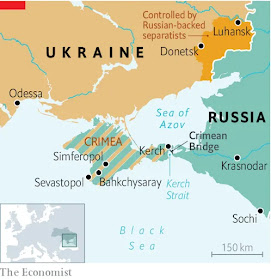
On another level, despite winning the Cold War, the United States and NATO are still searching for what defines their membership and its goals for the 21st Century.  During the Trump Administration, the former president chastised member nations who were not spending at least 2% of their aggregate GDP on military expenditures.  President Trump was able to get some of them to increase spending to fund their own defense and shared funding of the alliance (as of this writing, 10 of the military organization's 30 members have increased their expenditures close to 2% of their GDP, according to Stars & Stripes Magazine-10/21/20). I suspect that increase was less to do with Mr. Trump, and more to do with Russia's aggressive behavior over the last few years, which includes the annexation of the Crimean Peninsula and control of the Donbas region (southeastern Ukraine), including cities like Donetsk and Luhansk (see map).

Additionally, many European countries have good diplomatic relations with Russia and do business with Russian companies including Gazprom, which exports natural gas to Western Europe.  What complicates matters is current American President Joe Biden, who recently waived proposed sanctions on a Russian company building the Nord Stream 2 pipeline, connecting Germany and Russia. Although some in the president's party and most Republicans were against it, Mr. Biden made this decision so that he would be able to curry favor with Germany (Europe's biggest economy), at a time when he needs their support, and avoid any serious public rift with an ally.  The U.S. Department of State felt waiving sanctions against the Russian company and a notable Russian executive was in the best interests of the United States (BBC-5/20/21).

Finally, I suspect the powerful Department of Defense (DoD) and the military-industrial complex are pushing a more aggressive stance since any short conventional war will reap large profits before a cease-fire is introduced.  Who else would be pushing for this? Having Ukraine join NATO provides no desirable asset to the alliance.  The country brings nothing to the table and increases the anger and steadfast opposition of the Russian Federation. In my opinion, the most logical reason for the push to admit Ukraine into NATO is that it will bring about a continued increase in the American defense budget.  Since most of the countries in NATO require the Americans to provide the lion's share of the money, force projection, and power, the obvious "follow the money" analogy is to find out which companies will produce the weapons, which are the influential members of the military-industrial complex: Boeing, Lockheed-Martin, Raytheon, General Dynamics, Electric Boat, and Northrup Grumman.

Let the Russians and Ukrainians work it out.  If that means Ukraine loses the Crimean Peninsula (which has a large percentage of Russian speakers, in addition to those who have deep ties and loyalty to Russia), and the coveted Russian naval base at Sevastopol, it is a small price to pay for peace.  The United States Congress will find other ways, means, and potential conflicts to scare the American public into supporting larger defense spending.  A war over Ukraine is not in the interests of the United States, its military personnel, or NATO membership.  America should sit this conflict out, and signal to Russia that the United States will be pragmatic about this issue, something its foreign policy establishment has not done in quite some time.

Saturday, September 11, 2021

America should leave Afghanistan to the Afghans.


September 11, 2021


This is finally the year the United States left Afghanistan to the Afghans.  The war in this country had stretched to almost 20 years, and the goals to end this war have regularly evolved. To use American vernacular, it amounts to "moving the goalposts." This is essentially saying there are no real concrete plans, and the end game changed to suit whatever the current White House occupant wanted it to be.  It is time to honor those who have served, have sacrificed and to save future soldiers and Marines from being killed in a war without an end in sight. It was right to leave the country, but the Biden administration seemingly botched the process, and the horrific events that news media highlighted last week have made it resemble the last days of American involvement in Vietnam. Or perhaps worse.

________________________________


"Because the goal is NOT to completely subjugate Afghanistan.  The goal is to use Afghanistan to wash money out of the tax bases of the United States, out of the tax bases of European countries, through Afghanistan, and back into the transnational security elite.  That is the goal.  The goal is to have an endless war, not a successful war." - Julian Assange, 2011


The recent developments in Afghanistan had many Americans asking, why are we still defending that country?  The United States military spent trillions of dollars invading the country to rid it of Al-Qaeda, Osama bin Laden, Mullah Omar, and the Taliban within months of the September 11th attacks. These original goals had overwhelming support from the American people. After the death of Osama bin Laden, there really was no plan for the remainder of the American military's time in the "Graveyard of Empires."

The jarring images of chaos in the Afghan capital, including the streets being overrun with people wanting to flee the fast-approaching Taliban, were heartbreaking.  Adding to that were the horrific images of Afghanis trying desperately to hold onto American military transport planes taking off from Hamid Karzai International Airport.  The suicide bombing that happened near the Abbey Gate of the airport, which killed 13 servicemen and women (11 U.S. Marines, 1 U.S. Navy medic, and 1 U.S. Army Sergeant) was crippling for the morale amongst Americans still trapped in the country and those watching at home.

The American taxpayer has been funding this drawn-out war with little to show for it.  The Special Inspector General for Afghan Reconstruction (SIGAR), John Sopko, had reported his findings to Congress, but sadly very few people who have influence in Washington, D.C. took his views as guidance.  As a result, the United States continued to spend money on war and nation-building that's proved unfruitful.  Any cost-benefit analysis, even those by college students, would show that what we were spending money on was not bearing results that would warrant continued spending.  The metric being used was "good intentions," rather than effectual outcomes.

What are some of the primary motivations and reasons behind these military conflicts and fruitless nation-building endeavors?  As the saying goes, "Success has many fathers, but failure is an orphan." Had the Iraq War and Afghanistan conflict borne success and was generally popular, everyone in Washington, D.C., including former GOP and Democratic administration staffers, former Presidents Bush, Obama, and Trump, Beltway think tanks, and anyone who spent time in those war zones would be screaming to anyone who is within earshot that they are the reason these endeavors were successful. All those involved were reluctant to admit failure and designate this conflict as a waste of American resources.  It is one of the primary reasons the war in Afghanistan dragged for more than a decade longer than it should have.

While reading various media platforms, individual bloggers, and writers, I took away from their commentaries that a lot of the blame should lay at the feet of the bloated and gargantuan military-industrial complex, which now includes corporate media. Wars in the modern era for the United States tend to bring about profit for those who have a vested financial interest: Pentagon budget planners, Raytheon, Lockheed-Martin and other defense contractors, such as Halliburton, shareholders of these companies, including members of Congress and large corporations that own news networks. Their motivation is not about victories in the field, but on advertising revenues for their "newscasts," quarterly profits, and diverse investment portfolios.

Department of Defense weapons procurers, their friends in Congress, had their hands in the cookie jar of this war. They were more interested in justifying large military budgets, rather than a sound plan for victory and to leave.  For everyone involved, making money from the war was the primary reason that no one in Congress considered that our involvement should have an endpoint.  The grift was the fuel that kept the gravy train moving. Matt Taibbi wrote on his Twitter feed recently that roughly 30% of money spent for Afghanistan was fraud and waste. That is a good description of why the United States spent so much time in that country. The motivation was not to turn Afghans into adherents and supporters for Western-style democracy but to allow as many hungry parties to feed off the bloated government-funded war trough.  

If America was serious about investment in that country, to me it required a 100-year commitment of U.S. taxpayer support. This is a country that has never shown over its history that it will accept a centralized government based on Western values, and based in part on Judeo-Christian tenets of governance. Afghans tend to be tribal, with loyalties to various groups constantly warring with each other (for example, Pashtuns, Tajiks, and Uzbeks), a foundation with too much historical conflict that precludes building a governing coalition in 20 years. Developing productive relationships with tribal factions inside Afghanistan was hard enough.  It is a serious endeavor for one country alone to provide needed support. Members of the European Union and NATO did send personnel; however, it was dwarfed by the investment on all levels by the United States. All this effort was for a country that lacked a national character or shared values and morals. I think President Biden saw that writing on the wall (or his notecard) and realized that the folly of our time in Central Asia was over. Or, perhaps, he was trying to find an excuse to move military assets to different locations on the world chessboard.

All of what I described has played a large part in why we never made serious progress.  Additionally, the Taliban are the latest tribal incarnation of a hardened people who have a long history of defying foreign invaders. The Taliban were proud to mention to Western media that America had all the nicest watches, but the Taliban had all the time.  This was their country and knew it best, understood its history, its people, and the character of what it stood for.  The Afghan Army neither had the will nor the strength required to fight and win a war of attrition, despite receiving nearly $85 billion in Pentagon investments (Haaretz).

Craig Whitlock, an investigative reporter for the Washington Post and Pulitzer Prize recipient, on Bill Maher's Real Time, gave an example of the folly of war in Afghanistan. He described how the military would build bridges in remote parts of the country, requested by one community.  The bridge would then be destroyed by the Taliban.  Then the bridge would have to be rebuilt with taxpayer money again.  This self-fulfilling circle complete with corruption and bribery exemplified the American mission in Afghanistan.  Fighting the Taliban was secondary to that mission.  

America had not the faintest idea of how to nation-build in a country that never wanted to build anything for itself.  The SIGAR report gave a detailed example of how contractors and those entrusted to train the Afghan National Police watched episodes of CSI and Law and Order to figure out how to train that police force, clearly an utter joke.  The dedicated soldiers, sailors, airmen, and Marines made every effort to do their best with the goals they were given. The unfortunate part is that those who were entrusted to lead our nation, defense department, and senior flag officers in the Pentagon were either never serious about their strategy, or were obfuscating the realities on the ground.  As with most recent American wars, the men and women of our military won major battles, but the leadership elites in the United States lost the long war in the end but benefited in other ways.

What becomes of Afghanistan now? I suspect there were ulterior motives for this wasted war, and those reasons will not come out any time soon.  Perhaps down the road the American people will figure out or have genuine investigative reporters provide that blueprint for them. Those who gave their sons and daughters need to hear it the most. I have read that the country is rich in agricultural products (opium) and that is one of the methods the Taliban used to fund itself over the years. Afghanistan is rumored to have rich mineral deposits (Lithium) as well. The newly restored Taliban government will make use of these additional revenue streams and do business with many countries that have a vested interest in competing against American military, technological and economic power (China, Russia, Iran, Pakistan) once we remove all relevant embassy and military staff from the country. I suspect our elites have already made off like bandits, literally, and have no interest in how Afghanistan conducts its external affairs now. There is no shortage of shame, and that cannot be said enough.

Right now, political pundits and paid contributors for the major cable news networks are mouthing the theme that the American military didn't really "lose" the war, but instead on how we conducted a war that ended in defeat.  Many of these talking heads tend to be former military officials, think tank staffers, and former political operatives who earn income serving on corporate boards or act as advisors to the large defense contractors, and other companies who earn massive amounts of revenue for drawn-out wars.  Their motivation was to provide excuses for our failures in Afghanistan and Iraq.  For the elites in our government, and in various administrations, there is no price to pay for failure, being wrong in foreign policy, and making mistakes for those decisions.  That is partly due to a near-monopoly between two political parties who take turns running our country.

How do we end this cycle of never-ending war, nation-building, and perpetual government waste? Matt Taibbi, the independent investigative reporter I mentioned earlier, I think has the "write" stuff, and he wrote on his Substack page that the emergence of strong, effective new parties can change the game. I think that is the best option for the near future. The incumbent GOP and the Democrats do not have to change or adapt their ideologies because the electorate does not punish both parties. Contrarians can always point out that any new party or parties will fall prey to the same issues that affect the parties now, heavy dependence on campaign cash, influence from wealthy donors, and the ability of political power to corrupt anyone.  While these things might be true, the only real power voters have in a democracy is for people in leadership to be removed for their decisions.  American politics gives the advantage to the well-funded candidate or party, but strength in numbers, educated and knowledgeable voters, and a desire to win for a cause greater than personal politics can achieve better results for a citizen's movement in this country.

If the American people do not take democracy into their own hands and be assertive in their vote about the recent foreign policy failures around the world, highlighted by Iraq and Afghanistan, then nothing will change.  The carnage we as a nation inflict on countries and their populations, the wasteful and fraudulent expenses from our military and administrative spending, the leadership in subsequent administrations never being accountable or punished for their arrogance and failures will eventually damage our democracy. The loss of valuable and courageous American servicemen and women will continue. It will erode our influence in the world, our allies will lose faith in American power, and it will expedite our decline.

If we the American people do not learn from our time in Afghanistan, take the lessons from its failure and apply them to future foreign policy decisions, then that will be the final tragedy and loss from the war.


Wednesday, August 11, 2021

Will Texas and Oklahoma to the SEC Ruin College Football?


August 11, 2021


The recent blockbuster news that college football bluebloods the University of Texas Longhorns and the Oklahoma University Sooners will leave their Big 12 athletic conference, and move to the Southeastern Conference (SEC), to drastically increase their annual revenue, has shocked the American sports world.  Critics, which include their old Big 12 schools, feel that this is a shameless money grab that discards old relationships. Will this ruin the beauty, pageantry, and spirit of college football?

____________________________________


I was surprised myself when I heard that Texas and Oklahoma, two of college football's most glamorous programs, will leave the Big 12 conference they have called home since 1996, and move to the sport's most powerful and influential conference, the Southeastern Conference (SEC) for membership.  This is less about competitiveness and more about securing themselves a more financially secure future.  Both schools are two successful programs in football and have athletes in other sports (non-revenue such as soccer, track & field, baseball), but this move was purely about football alone.  The amount of annual revenue that both schools earn from their Big12 television contract is somewhere around $38 million. That is not a number to frown about but pales in comparison to what SEC-member schools get (roughly $45 million per year), and with the inclusion of Texas and Oklahoma, that number is going to increase.

With the two new additions, the projected SEC payouts could dramatically increase to over $60 million, give or take a few million.  The actual numbers will bear out in the coming years.  Some analysts of college football say a new television contract with the SEC and ESPN could bring close to $1 billion annually. It would rival the annual money that the NCAA earns with television networks for its administration of March Madness, the lucrative men's college basketball tournament that enraptures the country in March every year and makes it very hard for the other conferences to match them in money, and eventually, competitiveness.  Very likely, it would become a fool's errand to compete with schools in that conference, which in the long-term, may doom college football.  Why would the general public want to watch schools from the same conference every year compete for a "national championship" if most teams from the rest of the country are left out according to a format created and endorsed by a sports network (ESPN) that has the largest media rights for that conference (SEC)?

There are already rumblings of more schools wanting to join. The Florida State University Seminoles and the Clemson University Tigers, powers within the Atlantic Coast Conference (ACC), have made subtle and esoteric comments which imply that they don't want to be left without a chair with the conference alignment dance ends.  Endless rumors spread like wildfire, including claims that the SEC has made overtures to Michigan and Ohio State, mega brands in the BIG10. That conference, by the way, generates more revenue per school than the SEC.  Why would those schools want to leave a conference that makes money for its members, and has many schools that have academic prestige,  including membership in the Association of American Universities (AAU), something the SEC does not have in abundance?  The rumors get more insane with west coast power, and fellow blue blood, the University of Southern California (USC Trojans), a Pacific Conference (PAC-12) power joining the BIG10.  

Why would USC want to join a conference where they have no history?  I get money motivates these schools, but I don't think the Trojan fanbase would approve it.  The west coast is a great conference, one that produces individual and team champions that very few conferences can challenge.  The PAC-12 has the most individual Olympians and ranks 1st through 3rd in the number of most NCAA team champions.  The primary issue that USC and other PAC-12 powers complain about is that their football television contracts do not generate the same amount of money as the BIG10 and the SEC. Additionally, since they play on the "late coast," their games are shown at a time when many of the sports media have gone to bed, cannot or do not want to watch their games at a late hour.

Will these moves eventually force a break between these schools and the NCAA? Something similar was done to English soccer.  For many years, soccer in England resembled a pyramid, where the top clubs competed against one another in Division 1. If they had bad seasons, the teams at the bottom of the 1st division were "relegated," and teams from the second division below were "promoted" to the top division. This was the format for the lower professional leagues as well and was the way of doing things for decades.  In the early 1990s, some of the legendary clubs in English soccer (Manchester United, Liverpool, Arsenal) wanted to break away and earn their own money, while protecting parts of the functioning pyramid, to some extent.  This gave birth to the English Premier League, which has now become the richest soccer league in the world. The league can negotiate its media rights deals separately from the other divisions.  It creates a massive wealth disparity between wealthy clubs and those that have bare-bones team wages, but I assume it is tolerated because teams from lower divisions can qualify for the top flight of that country's soccer, and benefit from the aggregate revenue that teams in the top division receive once they get promoted.

I believe something similar will happen to college football.  The SEC has started what many believe will be a domino effect, and some blue blood programs will join that conference, mostly from the ACC (Florida State, Clemson, and perhaps the University of Miami).  However, I think the BIG10 and the Pac-12 will coordinate and work together to preserve what little competition remains in the top rung of college football.  Will that be a massive, joint league between those two conferences, or will it be an agreement to have a certain number of non-conference games against each other?  I think this is a good thing, rather than a bloated "super" conference.  If those conferences, along with the ACC and perhaps another conference, can create an "Intra-Conference Championship," which if marketed properly to generate fan interest and sponsorship, could realistically compete with the so-called SEC/National Championship.  It really comes down to how you create something out of this conference alignment chaos.  The key for school presidents, and conference commissioners is not to make rash decisions or partake in any decisions that are based on "fear of missing out" (FOMO) during this tumultuous time.  

Whatever decisions media companies, school officials, and trustees make, I think that sadly, college football will never be the same.  Greed, lack of loyalty to fellow conference members, and the selfishness of certain leaders in the sport will have long-lasting effects that won't bode well for its sustained popularity.  Many schools who are left out of musical chairs between the mega-conferences may end up getting rid of football, which is generally the largest expense for universities' athletic budgets.  Those players that are good enough will be absorbed by the larger schools, which should improve the talent on their rosters, but it will ruin the fabric of community between fans of the smaller schools that are left out of the money game in college sports.  

There will be contraction amongst those universities who determine that offering college sports to their student body will not be financially tenable.  The National Collegiate Athletic Association (NCAA) which for many years ruled college athletics outside of football, is in danger of becoming irrelevant.  The re-alignment and shifting of power to the SEC and forcing other conferences to make changes and leave old relationships will eventually make the organization a toothless behemoth.  College football powers will most likely create their own governing body, in relation to football, similarly to the Premier League, and have control over negotiating their revenue streams and determining a champion.  Whether that means all the power conferences are included in this governing body is yet to be determined.

I think the sudden departure of Texas and Oklahoma to the SEC has set in motion a chain reaction that will ultimately damage college football.  What made this sport have such passionate fanbases and increased its national popularity were the regional and historic rivalries (Nebraska v Oklahoma, USC v Notre Dame) and economic (Texas v Texas A&M, Washington v Washington State), with possibilities of upsets and dream seasons, and that most likely will be lost over time. Power and money are what is motivating these schools, more than loyalty and protecting long-standing relationships.  Once you destroy what made college football great, you will eventually ruin the sport itself.  That is the lasting legacy of what Texas and Oklahoma are doing by leaving their old conference and moving to the current flavor of the moment, the SEC.


US Men's Soccer: New World Cup, Same Result

  July 22, 2026 Since FIFA announced 8 years ago that the United States, Mexico, and Canada would jointly host the 2026 World Cup, anticipat...