Search This Blog

Wednesday, January 19, 2022

Ukraine is not worth the price of war with Russia


January 22, 2022


The last few months have seen major saber-rattling between nuclear powers Russia and the United States, not over world domination, but instead over a former member of the old Soviet Union, Ukraine.  Since its independence, the country has tried to become a semblance of a free-market economy, but that has proven difficult and it has also sought membership in the ever-expanding trans-Atlantic military alliance, the North Atlantic Treaty Organization (NATO).  Russia, to no one's surprise, is vehemently opposed to this idea because it would bring that alliance to its own border.

___________________________

Ukraine was the crown jewel, the centerpiece, if you will, of the large network of socialist states that made up the Union of Soviet Socialist Republics (USSR), during the heady days of the Cold War and the Iron Curtain that fell between the liberal democracies of the West, and those countries. Collectively they became the obedient states that adhered to whatever Moscow wanted.  After the disintegration of the USSR, Ukraine became an independent state, one that sought to be part of the European community, rather than a client state of the new Russian Federation.

For most of its independence, Ukraine has trundled along its new chartered path toward democracy, but that has been difficult, rife with disputed elections and the removal and ouster of elected presidents.  Corruption is rampant and a stain on their international aspirations. Nevertheless, the Ukrainians have persisted with their European dreams, both to be part of the European Union (EU) and for security purposes, desired membership in NATO, and follow in the footsteps of their Eastern Bloc brethren Latvia, Lithuania, and Estonia.

Russia, having lost the ideological battle to keep those Baltic states within its sphere of influence, absolutely will not contemplate the fearful idea of losing Ukraine to NATO and American influence, which is why 100,000 Russian troops are stationed across the border.  It sends a strong message of intent.  Those are the battle lines that have been drawn, and one I think Russia will come out ahead, for many reasons.

For one, most Americans are not sold on the idea that American lives are worth any conflict with Russia.  Ukraine is a beautiful country, with citizens one can root for who seek a higher quality of life and better opportunities after decades of living under socialism.  However, America has ended two long and costly wars in Iraq and Afghanistan, where trillions of dollars have been spent attempting to turn those countries into less volatile, but newly emerging democratic countries with rights for all.  With the recent Taliban takeover of Afghanistan (after a twenty-year absence), and Iraq being turned into a client state of Iran, due to its 69% Shia majority population, those endeavors have failed on a large scale.  A conflict with Russia, which has better trained and equipped soldiers than the Iraqi and Afghan fighters, will be far more difficult to defeat.  Not to mention, more financial resources and better planes, tanks, and artillery pieces.

The United States has been arming the Ukrainian military with mostly defensive weapons, including the Javelin anti-tank missile launcher. However, the Russians have in large supply their best weapons with offensive capabilities, and it appears the Ukrainians will be outmatched and outgunned in any armed conflict.

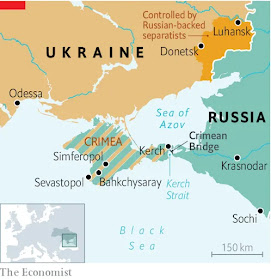
On another level, despite winning the Cold War, the United States and NATO are still searching for what defines their membership and its goals for the 21st Century.  During the Trump Administration, the former president chastised member nations who were not spending at least 2% of their aggregate GDP on military expenditures.  President Trump was able to get some of them to increase spending to fund their own defense and shared funding of the alliance (as of this writing, 10 of the military organization's 30 members have increased their expenditures close to 2% of their GDP, according to Stars & Stripes Magazine-10/21/20). I suspect that increase was less to do with Mr. Trump, and more to do with Russia's aggressive behavior over the last few years, which includes the annexation of the Crimean Peninsula and control of the Donbas region (southeastern Ukraine), including cities like Donetsk and Luhansk (see map).

Additionally, many European countries have good diplomatic relations with Russia and do business with Russian companies including Gazprom, which exports natural gas to Western Europe.  What complicates matters is current American President Joe Biden, who recently waived proposed sanctions on a Russian company building the Nord Stream 2 pipeline, connecting Germany and Russia. Although some in the president's party and most Republicans were against it, Mr. Biden made this decision so that he would be able to curry favor with Germany (Europe's biggest economy), at a time when he needs their support, and avoid any serious public rift with an ally.  The U.S. Department of State felt waiving sanctions against the Russian company and a notable Russian executive was in the best interests of the United States (BBC-5/20/21).

Finally, I suspect the powerful Department of Defense (DoD) and the military-industrial complex are pushing a more aggressive stance since any short conventional war will reap large profits before a cease-fire is introduced.  Who else would be pushing for this? Having Ukraine join NATO provides no desirable asset to the alliance.  The country brings nothing to the table and increases the anger and steadfast opposition of the Russian Federation. In my opinion, the most logical reason for the push to admit Ukraine into NATO is that it will bring about a continued increase in the American defense budget.  Since most of the countries in NATO require the Americans to provide the lion's share of the money, force projection, and power, the obvious "follow the money" analogy is to find out which companies will produce the weapons, which are the influential members of the military-industrial complex: Boeing, Lockheed-Martin, Raytheon, General Dynamics, Electric Boat, and Northrup Grumman.

Let the Russians and Ukrainians work it out.  If that means Ukraine loses the Crimean Peninsula (which has a large percentage of Russian speakers, in addition to those who have deep ties and loyalty to Russia), and the coveted Russian naval base at Sevastopol, it is a small price to pay for peace.  The United States Congress will find other ways, means, and potential conflicts to scare the American public into supporting larger defense spending.  A war over Ukraine is not in the interests of the United States, its military personnel, or NATO membership.  America should sit this conflict out, and signal to Russia that the United States will be pragmatic about this issue, something its foreign policy establishment has not done in quite some time.

Saturday, September 11, 2021

America should leave Afghanistan to the Afghans.


September 11, 2021


This is finally the year the United States left Afghanistan to the Afghans.  The war in this country had stretched to almost 20 years, and the goals to end this war have regularly evolved. To use American vernacular, it amounts to "moving the goalposts." This is essentially saying there are no real concrete plans, and the end game changed to suit whatever the current White House occupant wanted it to be.  It is time to honor those who have served, have sacrificed and to save future soldiers and Marines from being killed in a war without an end in sight. It was right to leave the country, but the Biden administration seemingly botched the process, and the horrific events that news media highlighted last week have made it resemble the last days of American involvement in Vietnam. Or perhaps worse.

________________________________


"Because the goal is NOT to completely subjugate Afghanistan.  The goal is to use Afghanistan to wash money out of the tax bases of the United States, out of the tax bases of European countries, through Afghanistan, and back into the transnational security elite.  That is the goal.  The goal is to have an endless war, not a successful war." - Julian Assange, 2011


The recent developments in Afghanistan had many Americans asking, why are we still defending that country?  The United States military spent trillions of dollars invading the country to rid it of Al-Qaeda, Osama bin Laden, Mullah Omar, and the Taliban within months of the September 11th attacks. These original goals had overwhelming support from the American people. After the death of Osama bin Laden, there really was no plan for the remainder of the American military's time in the "Graveyard of Empires."

The jarring images of chaos in the Afghan capital, including the streets being overrun with people wanting to flee the fast-approaching Taliban, were heartbreaking.  Adding to that were the horrific images of Afghanis trying desperately to hold onto American military transport planes taking off from Hamid Karzai International Airport.  The suicide bombing that happened near the Abbey Gate of the airport, which killed 13 servicemen and women (11 U.S. Marines, 1 U.S. Navy medic, and 1 U.S. Army Sergeant) was crippling for the morale amongst Americans still trapped in the country and those watching at home.

The American taxpayer has been funding this drawn-out war with little to show for it.  The Special Inspector General for Afghan Reconstruction (SIGAR), John Sopko, had reported his findings to Congress, but sadly very few people who have influence in Washington, D.C. took his views as guidance.  As a result, the United States continued to spend money on war and nation-building that's proved unfruitful.  Any cost-benefit analysis, even those by college students, would show that what we were spending money on was not bearing results that would warrant continued spending.  The metric being used was "good intentions," rather than effectual outcomes.

What are some of the primary motivations and reasons behind these military conflicts and fruitless nation-building endeavors?  As the saying goes, "Success has many fathers, but failure is an orphan." Had the Iraq War and Afghanistan conflict borne success and was generally popular, everyone in Washington, D.C., including former GOP and Democratic administration staffers, former Presidents Bush, Obama, and Trump, Beltway think tanks, and anyone who spent time in those war zones would be screaming to anyone who is within earshot that they are the reason these endeavors were successful. All those involved were reluctant to admit failure and designate this conflict as a waste of American resources.  It is one of the primary reasons the war in Afghanistan dragged for more than a decade longer than it should have.

While reading various media platforms, individual bloggers, and writers, I took away from their commentaries that a lot of the blame should lay at the feet of the bloated and gargantuan military-industrial complex, which now includes corporate media. Wars in the modern era for the United States tend to bring about profit for those who have a vested financial interest: Pentagon budget planners, Raytheon, Lockheed-Martin and other defense contractors, such as Halliburton, shareholders of these companies, including members of Congress and large corporations that own news networks. Their motivation is not about victories in the field, but on advertising revenues for their "newscasts," quarterly profits, and diverse investment portfolios.

Department of Defense weapons procurers, their friends in Congress, had their hands in the cookie jar of this war. They were more interested in justifying large military budgets, rather than a sound plan for victory and to leave.  For everyone involved, making money from the war was the primary reason that no one in Congress considered that our involvement should have an endpoint.  The grift was the fuel that kept the gravy train moving. Matt Taibbi wrote on his Twitter feed recently that roughly 30% of money spent for Afghanistan was fraud and waste. That is a good description of why the United States spent so much time in that country. The motivation was not to turn Afghans into adherents and supporters for Western-style democracy but to allow as many hungry parties to feed off the bloated government-funded war trough.  

If America was serious about investment in that country, to me it required a 100-year commitment of U.S. taxpayer support. This is a country that has never shown over its history that it will accept a centralized government based on Western values, and based in part on Judeo-Christian tenets of governance. Afghans tend to be tribal, with loyalties to various groups constantly warring with each other (for example, Pashtuns, Tajiks, and Uzbeks), a foundation with too much historical conflict that precludes building a governing coalition in 20 years. Developing productive relationships with tribal factions inside Afghanistan was hard enough.  It is a serious endeavor for one country alone to provide needed support. Members of the European Union and NATO did send personnel; however, it was dwarfed by the investment on all levels by the United States. All this effort was for a country that lacked a national character or shared values and morals. I think President Biden saw that writing on the wall (or his notecard) and realized that the folly of our time in Central Asia was over. Or, perhaps, he was trying to find an excuse to move military assets to different locations on the world chessboard.

All of what I described has played a large part in why we never made serious progress.  Additionally, the Taliban are the latest tribal incarnation of a hardened people who have a long history of defying foreign invaders. The Taliban were proud to mention to Western media that America had all the nicest watches, but the Taliban had all the time.  This was their country and knew it best, understood its history, its people, and the character of what it stood for.  The Afghan Army neither had the will nor the strength required to fight and win a war of attrition, despite receiving nearly $85 billion in Pentagon investments (Haaretz).

Craig Whitlock, an investigative reporter for the Washington Post and Pulitzer Prize recipient, on Bill Maher's Real Time, gave an example of the folly of war in Afghanistan. He described how the military would build bridges in remote parts of the country, requested by one community.  The bridge would then be destroyed by the Taliban.  Then the bridge would have to be rebuilt with taxpayer money again.  This self-fulfilling circle complete with corruption and bribery exemplified the American mission in Afghanistan.  Fighting the Taliban was secondary to that mission.  

America had not the faintest idea of how to nation-build in a country that never wanted to build anything for itself.  The SIGAR report gave a detailed example of how contractors and those entrusted to train the Afghan National Police watched episodes of CSI and Law and Order to figure out how to train that police force, clearly an utter joke.  The dedicated soldiers, sailors, airmen, and Marines made every effort to do their best with the goals they were given. The unfortunate part is that those who were entrusted to lead our nation, defense department, and senior flag officers in the Pentagon were either never serious about their strategy, or were obfuscating the realities on the ground.  As with most recent American wars, the men and women of our military won major battles, but the leadership elites in the United States lost the long war in the end but benefited in other ways.

What becomes of Afghanistan now? I suspect there were ulterior motives for this wasted war, and those reasons will not come out any time soon.  Perhaps down the road the American people will figure out or have genuine investigative reporters provide that blueprint for them. Those who gave their sons and daughters need to hear it the most. I have read that the country is rich in agricultural products (opium) and that is one of the methods the Taliban used to fund itself over the years. Afghanistan is rumored to have rich mineral deposits (Lithium) as well. The newly restored Taliban government will make use of these additional revenue streams and do business with many countries that have a vested interest in competing against American military, technological and economic power (China, Russia, Iran, Pakistan) once we remove all relevant embassy and military staff from the country. I suspect our elites have already made off like bandits, literally, and have no interest in how Afghanistan conducts its external affairs now. There is no shortage of shame, and that cannot be said enough.

Right now, political pundits and paid contributors for the major cable news networks are mouthing the theme that the American military didn't really "lose" the war, but instead on how we conducted a war that ended in defeat.  Many of these talking heads tend to be former military officials, think tank staffers, and former political operatives who earn income serving on corporate boards or act as advisors to the large defense contractors, and other companies who earn massive amounts of revenue for drawn-out wars.  Their motivation was to provide excuses for our failures in Afghanistan and Iraq.  For the elites in our government, and in various administrations, there is no price to pay for failure, being wrong in foreign policy, and making mistakes for those decisions.  That is partly due to a near-monopoly between two political parties who take turns running our country.

How do we end this cycle of never-ending war, nation-building, and perpetual government waste? Matt Taibbi, the independent investigative reporter I mentioned earlier, I think has the "write" stuff, and he wrote on his Substack page that the emergence of strong, effective new parties can change the game. I think that is the best option for the near future. The incumbent GOP and the Democrats do not have to change or adapt their ideologies because the electorate does not punish both parties. Contrarians can always point out that any new party or parties will fall prey to the same issues that affect the parties now, heavy dependence on campaign cash, influence from wealthy donors, and the ability of political power to corrupt anyone.  While these things might be true, the only real power voters have in a democracy is for people in leadership to be removed for their decisions.  American politics gives the advantage to the well-funded candidate or party, but strength in numbers, educated and knowledgeable voters, and a desire to win for a cause greater than personal politics can achieve better results for a citizen's movement in this country.

If the American people do not take democracy into their own hands and be assertive in their vote about the recent foreign policy failures around the world, highlighted by Iraq and Afghanistan, then nothing will change.  The carnage we as a nation inflict on countries and their populations, the wasteful and fraudulent expenses from our military and administrative spending, the leadership in subsequent administrations never being accountable or punished for their arrogance and failures will eventually damage our democracy. The loss of valuable and courageous American servicemen and women will continue. It will erode our influence in the world, our allies will lose faith in American power, and it will expedite our decline.

If we the American people do not learn from our time in Afghanistan, take the lessons from its failure and apply them to future foreign policy decisions, then that will be the final tragedy and loss from the war.


Wednesday, August 11, 2021

Will Texas and Oklahoma to the SEC Ruin College Football?


August 11, 2021


The recent blockbuster news that college football bluebloods the University of Texas Longhorns and the Oklahoma University Sooners will leave their Big 12 athletic conference, and move to the Southeastern Conference (SEC), to drastically increase their annual revenue, has shocked the American sports world.  Critics, which include their old Big 12 schools, feel that this is a shameless money grab that discards old relationships. Will this ruin the beauty, pageantry, and spirit of college football?

____________________________________


I was surprised myself when I heard that Texas and Oklahoma, two of college football's most glamorous programs, will leave the Big 12 conference they have called home since 1996, and move to the sport's most powerful and influential conference, the Southeastern Conference (SEC) for membership.  This is less about competitiveness and more about securing themselves a more financially secure future.  Both schools are two successful programs in football and have athletes in other sports (non-revenue such as soccer, track & field, baseball), but this move was purely about football alone.  The amount of annual revenue that both schools earn from their Big12 television contract is somewhere around $38 million. That is not a number to frown about but pales in comparison to what SEC-member schools get (roughly $45 million per year), and with the inclusion of Texas and Oklahoma, that number is going to increase.

With the two new additions, the projected SEC payouts could dramatically increase to over $60 million, give or take a few million.  The actual numbers will bear out in the coming years.  Some analysts of college football say a new television contract with the SEC and ESPN could bring close to $1 billion annually. It would rival the annual money that the NCAA earns with television networks for its administration of March Madness, the lucrative men's college basketball tournament that enraptures the country in March every year and makes it very hard for the other conferences to match them in money, and eventually, competitiveness.  Very likely, it would become a fool's errand to compete with schools in that conference, which in the long-term, may doom college football.  Why would the general public want to watch schools from the same conference every year compete for a "national championship" if most teams from the rest of the country are left out according to a format created and endorsed by a sports network (ESPN) that has the largest media rights for that conference (SEC)?

There are already rumblings of more schools wanting to join. The Florida State University Seminoles and the Clemson University Tigers, powers within the Atlantic Coast Conference (ACC), have made subtle and esoteric comments which imply that they don't want to be left without a chair with the conference alignment dance ends.  Endless rumors spread like wildfire, including claims that the SEC has made overtures to Michigan and Ohio State, mega brands in the BIG10. That conference, by the way, generates more revenue per school than the SEC.  Why would those schools want to leave a conference that makes money for its members, and has many schools that have academic prestige,  including membership in the Association of American Universities (AAU), something the SEC does not have in abundance?  The rumors get more insane with west coast power, and fellow blue blood, the University of Southern California (USC Trojans), a Pacific Conference (PAC-12) power joining the BIG10.  

Why would USC want to join a conference where they have no history?  I get money motivates these schools, but I don't think the Trojan fanbase would approve it.  The west coast is a great conference, one that produces individual and team champions that very few conferences can challenge.  The PAC-12 has the most individual Olympians and ranks 1st through 3rd in the number of most NCAA team champions.  The primary issue that USC and other PAC-12 powers complain about is that their football television contracts do not generate the same amount of money as the BIG10 and the SEC. Additionally, since they play on the "late coast," their games are shown at a time when many of the sports media have gone to bed, cannot or do not want to watch their games at a late hour.

Will these moves eventually force a break between these schools and the NCAA? Something similar was done to English soccer.  For many years, soccer in England resembled a pyramid, where the top clubs competed against one another in Division 1. If they had bad seasons, the teams at the bottom of the 1st division were "relegated," and teams from the second division below were "promoted" to the top division. This was the format for the lower professional leagues as well and was the way of doing things for decades.  In the early 1990s, some of the legendary clubs in English soccer (Manchester United, Liverpool, Arsenal) wanted to break away and earn their own money, while protecting parts of the functioning pyramid, to some extent.  This gave birth to the English Premier League, which has now become the richest soccer league in the world. The league can negotiate its media rights deals separately from the other divisions.  It creates a massive wealth disparity between wealthy clubs and those that have bare-bones team wages, but I assume it is tolerated because teams from lower divisions can qualify for the top flight of that country's soccer, and benefit from the aggregate revenue that teams in the top division receive once they get promoted.

I believe something similar will happen to college football.  The SEC has started what many believe will be a domino effect, and some blue blood programs will join that conference, mostly from the ACC (Florida State, Clemson, and perhaps the University of Miami).  However, I think the BIG10 and the Pac-12 will coordinate and work together to preserve what little competition remains in the top rung of college football.  Will that be a massive, joint league between those two conferences, or will it be an agreement to have a certain number of non-conference games against each other?  I think this is a good thing, rather than a bloated "super" conference.  If those conferences, along with the ACC and perhaps another conference, can create an "Intra-Conference Championship," which if marketed properly to generate fan interest and sponsorship, could realistically compete with the so-called SEC/National Championship.  It really comes down to how you create something out of this conference alignment chaos.  The key for school presidents, and conference commissioners is not to make rash decisions or partake in any decisions that are based on "fear of missing out" (FOMO) during this tumultuous time.  

Whatever decisions media companies, school officials, and trustees make, I think that sadly, college football will never be the same.  Greed, lack of loyalty to fellow conference members, and the selfishness of certain leaders in the sport will have long-lasting effects that won't bode well for its sustained popularity.  Many schools who are left out of musical chairs between the mega-conferences may end up getting rid of football, which is generally the largest expense for universities' athletic budgets.  Those players that are good enough will be absorbed by the larger schools, which should improve the talent on their rosters, but it will ruin the fabric of community between fans of the smaller schools that are left out of the money game in college sports.  

There will be contraction amongst those universities who determine that offering college sports to their student body will not be financially tenable.  The National Collegiate Athletic Association (NCAA) which for many years ruled college athletics outside of football, is in danger of becoming irrelevant.  The re-alignment and shifting of power to the SEC and forcing other conferences to make changes and leave old relationships will eventually make the organization a toothless behemoth.  College football powers will most likely create their own governing body, in relation to football, similarly to the Premier League, and have control over negotiating their revenue streams and determining a champion.  Whether that means all the power conferences are included in this governing body is yet to be determined.

I think the sudden departure of Texas and Oklahoma to the SEC has set in motion a chain reaction that will ultimately damage college football.  What made this sport have such passionate fanbases and increased its national popularity were the regional and historic rivalries (Nebraska v Oklahoma, USC v Notre Dame) and economic (Texas v Texas A&M, Washington v Washington State), with possibilities of upsets and dream seasons, and that most likely will be lost over time. Power and money are what is motivating these schools, more than loyalty and protecting long-standing relationships.  Once you destroy what made college football great, you will eventually ruin the sport itself.  That is the lasting legacy of what Texas and Oklahoma are doing by leaving their old conference and moving to the current flavor of the moment, the SEC.


Friday, June 18, 2021

Is Light Rail in Los Angeles County the Answer to Traffic Congestion?


June 15, 2021


For the past twenty years or so, public transportation in Los Angeles has seen a dramatic rise in revenue generation for projects around Los Angeles County (Measure R, Prop C, etc).  These goals include making it easier for residents to use public transit, alleviating traffic congestion, and accessibility to various locations (downtown LA-Red Line, Santa Monica-Expo Line, the Eastside, and the outer reaches of the San Gabriel Valley-Gold Line).  With all the money being put to use, are the goals expressed by the Los Angeles County Metro Transportation Authority (LACMTA) prudent?  Are LACMTA's Light Rail proposals and transportation aspirations the best way to alleviate traffic congestion in the most populous county in America?

_______________________________

The Los Angeles County Metropolitan Transportation Authority (LACMTA), commonly referred to as "Metro," became the new, single agency in Los Angeles County after a Sacramento politician initiated and passed a bill to combine two former transit agency rivals.  The Southern California Rapid Transit District (known as "SCRTD"), a transit operator, ran from the 1960s through the 1980s, and the Los Angeles County Transportation Commission (LACTC), a transportation funding and planning agency, was formed in 1976. Their rivalry caused serious problems for transit riders in the county and was carried through the formation of Metro in 1994.  The impetus for creating one main agency was the competition and lack of professionalism between RTD and the LACTC, the prime example being that a Blue Line light rail transit project (RTD) was terminated so close to the heavy rail Pico Station, six blocks to be exact, which was under the authority of the LACTC.  Richard Katz, a state assemblyman, joined public outrage, initiated, and successfully passed, a bill that would combine both agencies into the current LACMTA (wikipedia.org).

For those who are part of the Southern California "car culture," taking public transit is not something done on a regular basis. For most of the early 20th century, Los Angeles had an extensive trolley system that ran through a comprehensive network of rail lines throughout the city, and parts of the county. Pacific Electric ("Red Cars") ran the largest trolley system in the world in 1920s Los Angeles. It was joined by the Los Angeles Railway, which ran the other trolley, the "Yellow Cars," on their joint gauge. However, after revenue problems, along with the birth of more roads and the U.S. highway system, the extensive trolley system was slowly dismantled.  The state legislature, however, did create the first version of "Metro" in 1951 to control what was left of bus and rail transit in the city of Los Angeles, and outlying areas (Holmes,2020).

The first light rail line was the Blue Line, which originated from the South Bay (Long Beach) into downtown Los Angeles and began service in 1990. Other new lines have been built since then.  I had taken the Gold Line regularly for work in the past, a route that connected the San Gabriel Valley (it now extends to Azusa and East Los Angeles) and I found it to be a competent public transit system. There was a time when it had an Express Service, one that avoided stopping at all the stations along the route to the Union Station hub. It was terminated when it was proven to not save that much time off the regular routes.  Since that time, there have been extensions to the Gold Line, and a new line to Santa Monica, Expo Line, along with enhancements to other colored routes.  Recently, Metro changed the names of their rail and subway lines to a lettered system, similar to the subway system in New York. For example, the Gold Line is now known as the L Line.


In this century, Metro is betting big on rail transit in Los Angeles County. According to their published Long Range Transit Plan (LRTP) updated in 2020, it is an expansive, ambitious $400 billion transit plan over the next 30 years (https://www.metro.net/projects/lrtp/). Of that, the agency will spend approximately $61 billion on countywide rail and transitway capital projects through the year 2050, with the funds coming from voter-approved propositions from countywide sales taxes (Prop A, Prop C, Measure R, Measure M) programs, state, federal programs, and other sources (such as bonds). Some of these programs are part of Local Return, which are ordinances for sales tax initiatives that require the Metro to spend money to improve, support, or initiate transit projects within the county.  

The LRTP forecast is based on estimated sales tax revenue increases over several years and current project cost estimates.  If there are changes in revenue (for instance, the effects of the Covid-19 pandemic could be felt for years), it could throw them in doubt.  However, Metro states the 30-year forecasts for the LRTP can be updated to incorporate any current financial issues since it is a "living" document.  That being said, is rail investment the right idea to get behind?

The 2020 LRTP presents some ambitious plans for Metro, one of which is the expansion of rail transit countywide and in partnership with other transportation agencies.  Upon completion of current projects, new projects include four priority "pillar" projects: West Santa Ana Branch, Eastside Extension-Phase 2, C Line (Green) to Torrance, and Sepulveda Transit Corridor (metro.net/2020/lrtp).  Additionally, there are upgrades for Union Station, so that the iconic and telegenic train station will be able to support proposed projections of increased regional and intercity rail service.  Sales taxes from Measure R and Measure M will provide funds for these ambitious goals.

In addition to these rail projects, Metro plans to improve bus service, like increased travel speeds, all-door boarding, complementary paratransit service, signal priority for bus and rail service, continued coordination between Metro and other local transit agencies. It is detailed in the agency's NextGen Bus Plan, and include doubling the frequency of bus line service (10-minute intervals), improve and expand service, 7-day service week,  quarter-mile distance to a bus stop for commuters, and have those bus stops be more comfortable during wait times (metro.net/projects/nextgen). In my opinion, this is where Metro can make the most difference. Improving bus service will be the central tenet for making their goals achievable and is key to improving public transportation in Los Angeles County.

However, there has been push-back with regard to Metro's optimistic goals and revenue estimates. Over a series of critiques of Metro, two researchers, Thomas Rubin, and James Moore, with the Reason Foundation, performed reviews of various past and current endeavors of the transit agency, including their opinions on Metro's "28 by 2028," which is their plan to target projects that can be completed before the 2028 Olympics. While rail projects tend to get local media attention, it is bus service that generally brings in dependable revenue for Metro. According to the authors, bus service is very productive and cost-effective, and rail is not.  The authors examined Metro's FY14 Adopted Budget and found that the agency showed a preference to expand rail service and how it "misrepresented" the performance of bus service to support this direction (Rubin & Moore, 2019). However, the powers that be (or those with the most influence, which are I suspect are construction firms), Metro places more support for rail expansion than bus improvements. 

Misters Rubin and Moore went into additional time detailing their views of the problems with the business model of Metro.  They show how transit ridership has been declining from peak levels in the late 80s.  What is the cause for this, since the county's population has increased over the past 30 years?  Light rail has eaten into some of that ridership, but since it has leveled off, I don't see it as the sole reason for a lowering of bus service transit levels. The authors state that commuter levels have receded from bus service, but that rail has not received an increase in ridership from this change. They make the claim that the agency's LRTPs tend to overpromise and underdeliver (notably light rail projects that don't get built), and also overstates its projections based on sales tax initiatives the amount of revenue actually generated. They add that its most recent voter proposition, Measure M, will not provide the rosy revenue streams it promises.  These construction projects are likely to fail due to over-estimation of sales tax revenue and underestimation of construction costs projections (Rubin & Moore, 2019). Further, these authors state that even though Metro plans on light rail expansion, we may not see a transit commuter increase for those new rail lines, despite aspirational intentions. 

What is the long-term outlook for Metro?  While I feel that the city of Los Angeles had a pretty efficient public transit system before World War II, the proliferation of the automobile into middle-class families made that trolley transit system underutilized and outdated, and many of the rail lines throughout Los Angeles County were removed to make way for roads and highways.  That transformation increased through the latter half of the century, and no serious initiatives took place until after the merger between the SCRTD and LACTC. I think the formation of Metro gave those within the agency who were pushing for new transit projects an unchecked desire for increased construction for specific constituents in the business community.  While light rail, the underground subway, and Metrolink have given residents of the county more options to commute and travel throughout the region, the desired increases of those using public transit seem to have leveled off (like those who use bus transit). Low gas prices are part of that regression. Light rail has seen new riders of public transit, but I don't think the stated improvements to how people get around have been what city and county planners had envisioned.

Where do go from here? Based on the reporting of Rubin and Moore, Metro's projects to alleviate congestion may not be the best way forward.  Instead of constructing new light rail lines, more study needs to determine if these projects will do what they intend. Their studies, from the Reason Foundation, states otherwise.  It appears that county residents who use public bus transit have declined and rail use has not benefited.  Too many people who live in the county find traveling by car to be their preferred way to get around. Additionally, a study on behalf of the Southern California Association of Governments (SCAG), performed by UCLA's Institute of Transportation Studies, implied that lower-income county residents (the ones who use public transit the most) have access to own, and use cars more than in years past (Manville, Taylor, Blumberg-2018).  Electric cars, once they become affordable for the masses, could put a larger dent in Metro's hope to see more public transit once new light rail lines are completed. California is the state with the largest number of electric vehicles, and that number will continue to climb.  The California New Car Dealer Association (CNCDA) recorded data for electric car ownership, which saw an increase from 1.5% to 6% between 2015 and 2020 (cncda.org). With that upward trajectory, and the subsequent decrease in the need for gas-powered cars, will that drive more people to avoid taking public transit?

Using public transit should compete to become a better alternative to mitigate the stress of freeway gridlock for car drivers today.  Metro must focus and design its comprehensive transit system to move people quickly to the most popular and necessary destinations throughout the city (for example, LA Live/Staples, the Coliseum, Santa Monica, LAX, and beach cities) in the most efficient manner with seamless transfers to different bus and rail lines.  If despite improvements, it becomes a hassle to get around, people would rather spend their time in their cars.  Instead of spending billions of dollars on new rail projects, Metro would be wise to determine where the majority of county residents want to travel most frequently and in the shortest time frame and invest those dollars to make car travel less desirable.   Good intentions do not translate into new light rail riders.  Effective allocation of tax revenue that moves the most people to the right places will establish successful public transit in Los Angeles for the 21st Century. That is what I hope will be the primary focus instead of Metro's actual long-range transit plan.


Sources: https://en.wikipedia.org/wiki/Los_Angeles_County_Metropolitan_Transportation_Authority

Wednesday, April 28, 2021

The Short Life and Death of European Soccer's Super League


April 20, 2021

On Sunday, April 18th, the soccer world was shocked, then angered that twelve of European soccer's biggest brands, which include the Premier League's "Big Six," (Manchester United and Manchester City, Chelsea, Arsenal, Liverpool, and Tottenham) along with teams from Spain (Barcelona, Real Madrid, and Athletic Madrid) and Italy (AC Milan, Inter Milan, and Juventus), signed an initial agreement to join a Super League in Europe.  This would have been a mid-week competition solely for those teams, plus an additional 'lucky' five teams that would round out the 20-team competition. 

________________________________

The richest and most popular clubs in Europe got together and recently publicly released what was being discussed in soccer circles around the world, the creation of an exclusive, closed league for these specific clubs. It would allow them to be the prime beneficiaries of billions in new revenue, from corporate sponsorship and media rights.  One of the rumored sponsors was JP Morgan, while the media rights company was not known as of this blog post. When the soccer world heard of this, it was a profoundly surprising move by some of the richest soccer clubs in Europe.  The new, proposed tournament would be played outside of the current most popular club tournament in the world, the UEFA Champions League, and the powerful clubs would not be in danger of being demoted from the proposed league, which protects their financial interests.  

The fans of the top leagues, many of whom are supporters of the aforementioned clubs in Europe, were not happy with this proposal.  The blowback was so intense that many of the clubs that signed onto the agreement have now dropped out.  Manchester City, Liverpool, Arsenal, Chelsea, Manchester United, and Tottenham have stunningly told their fans and the wider sports world that they have withdrawn from the Super League in the last two days, some of whom withdrew after several hours after the announcement.  If six teams from the richest soccer league in the world decide to bow out, it doesn't matter what the other mega-clubs such as Real Madrid and FC Barcelona want to do.  The English league teams were key since they have the most money (as a group) and have more leverage than individual club powers from Spain and Italy.   

What is surprising is that global brands like Bayern Munich, Paris St. Germain (France), and Ajax (Netherlands) wanted no part of this Super League at all. Now, that could change in the future, but there must have been intense trepidation from those teams' upper management that they chose not to add their clubs to the public proclamation of the league.  In the Bundesliga, which is the German league, most of their teams have a 50+1 rule, in that no commercial or wealthy individual can own no more than 49% stake in any team, ensuring that club supporters control 51% of the voting rights stake.  That might be the primary reason no German team officially signed on to the Super League as a charter member. Those supporters had influence and were able to do what English soccer fans were not able to do, put pressure on their clubs before the proposed league announcement.

The goal of the Super League is similar to how the current top-flight league in English football, the widely popular Premier League, was formed in 1992. Which is, how to protect the large revenue stream for a small, select group of clubs instead of sharing it with all professional clubs including the lower levels of competition in the country. However, promotion and relegation were protected so that clubs in lower divisions had a chance to make it to the top flight and earn their share of the mammoth media rights revenue streams. The process got started when Greg Dyke, an influential media executive within British television, met with the largest clubs at the time (Arsenal, Manchester United, Liverpool, Tottenham, and Everton) in the old English Football League and suggested that their sport would be more lucrative if the bigger clubs were featured more regularly on television.  The Premier League played their first games in August of 1992 and were televised on Britain's ITV network.  The rest is history.  The Premier League today now draws enormous interest globally, and the result is that its revenue for media rights, licensing, and merchandise far outpaces other soccer leagues around the world.

I think that was the same goal for the Super League, but with a caveat.  Most of the name-brand soccer clubs would never be sent down to a lower league, and so they would be guaranteed to receive a share of revenue regardless of how they performed on the field.  Any of the big clubs can technically be demoted from their respective leagues, but most do not because they make so much money through aggregate revenue streams that they rarely fall below 14th in the league standings.  I think that is what angered fans the most, in that these clubs were simply chasing large amounts of money without being in danger of losing it to poor performance.  The smaller clubs in Europe's top leagues already lag behind clubs like Manchester United and Liverpool and to see these popular clubs promised even more money is too much to bear.  It will make those teams even more irrelevant. 

I think it is good that FIFA, the Football Associations (FA) where those teams play, and governing bodies of those top leagues are discussing punitive actions for those clubs for trying this.  FIFA and UEFA threatened players of those teams that they would be barred from playing in the FIFA World Cup and the UEFA Champions League if their teams broke away from those leagues.  It was a powerful threat that sent its intended message. Additionally, the leagues themselves should exclude representatives from the former Super League membership on influential committees.  Had the clubs actually broken away, Chelsea, Real Madrid and Manchester City would have been banished from the Semi-Finals of this year's Champions League tournament.

While those actions are a good first step, ultimately, they are reactionary.  If the owners of those respective clubs made an attempt at a shameless money grab once before, they will try again.   No one walks away from that much money.  Those who want to protect soccer/football must ensure that these rich clubs do not harm the game in order to enrich themselves.  FIFA and UEFA should make it a permanent rule that any player who signs with clubs who once again try to form a Super League will be banned from international competitions with their respective countries.  The soccer leagues must also remove those clubs from any type of competition within and with those leagues.  In essence, you must starve them of competition outside of themselves.  After a while, fans and players will get bored of playing the same people over and over again.  Football can still be saved, and money can be made.  However, these breakaways for cash must be put down for good, and if done properly, can ultimately protect the "beautiful game."


Thursday, April 8, 2021

U.S. Soccer Failure: Under-23 men's team fails to qualify for Olympics...Again.


April 6, 2021

After a defeat to Honduras (2-1) in Mexico for 2020 Olympic qualifying this past March, the Under-23 U.S.  men's soccer team failed for the third time in as many attempts over 12 years to gain qualification for the games.  Fool me once, shame on you. Fool me twice, shame on me. Fool me three times, shame on U.S. Soccer.  The problem may not be the players anymore.  Failure rests at the feet of how the U.S. Soccer runs its men's program.  To do nothing now is to ignore the rot at the top of American soccer's hierarchy, beginning and ending at the door of the United States Soccer Federation (USSF).

___________________________

For the last three Olympic qualifying campaigns, the United States Under-23 team failed to qualify for the  Olympic Games, including the upcoming games in Japan this year.  It is the same old story.  The primary problem, in my opinion, is that the USSF does not have any idea how to seek out talent and maximize their skills to win international tournaments, on any level, for that matter (youth teams or the senior men's team). 

The federation is essentially a non-profit that is designed to promote the sport of soccer through its national teams, specifically the men's and women's senior teams. The women's national team is the best in the world and consistently wins against overmatched and underfunded opponents. This is due to the fact that U.S. women have more rights and resources than women in other countries, so they are able to pursue their dreams.  

The soccer federation's imprint on the men's program, on the other hand, lags behind Mexico, Latin America, and Europe in terms of developing talent and utilizing them for the senior national team.  The Under-23 teams are part of this evolution. That process is damaged and stunted when the men's Under-23 teams are not able to test themselves against their peers from around the world on a regular basis in international tournaments.   

If the U.S Under-23s cannot win decisively against teams in their regions with smaller budgets and fewer resources (for example, Honduras, Costa Rica, El Salvador, Dominican Republic), how can one expect them to beat exceptional teams from Mexico, Italy, Germany, Holland, and Brazil at the World Cup? The program for that age group seems to be regressing, rather than progressing.

How does this failed method change?  The problem lies with the federation.  In other organizations, if there is failure to achieve stated goals or generate profit, the chief executive is held to account, and reform happens within the department itself, including how they operate and termination may ensue.  However, the USSF has not made any effort to alter the way it functions. It answers to no outside organization, but simply reports its expenditures to its own Board, most of whom have no soccer experience. The organization functions similarly to the Vatican, in that critics and reformers are powerless to make the change they want to see from the outside.  This explains the frustration of men's soccer fans who desperately want visionary leaders who can help the men's program improve its history and find success in the future.  

Drastic measures or necessary reforms are extremely hard for an organization that is under no pressure to change by sponsors to do so, and also doesn't fear any repercussions for its on-field failures. I believe these steps can bring about more accountability and better results:

  • If a coach has been chosen to whatever men's best team (First Team, Under 23s), his or her sole job should be to qualify for a specific tournament (World Cup, Olympics, Junior World Cups), and if the team does not qualify, then the day after, the coach must resign; no point in keeping an unsuccessful coach around if he or she didn't do what they were hired to do. If they qualify, they should get a bonus (if they don't already stipulate in their contracts) and must leave their position before qualification for another international tournament begins.  This will allow for new coaches to get a head start in selecting talent, and forming their teams, and playing cohesively together ahead of important competitions.  Exceptions with their contracts can be made when they are successful, as in the example of Joachim Low of Germany, who has coached the senior team for 15 years and has World Cup and European titles to his tenure.
  • Hire people who have a track record of winning and building talent in the soccer world, even if those people come from outside the American soccer community. The sport in the United States is run like a provincial village in Europe, in that everyone knows each other, and having the right connections gives you jobs over better-qualified outsiders. Merit must count. This is paramount in how the USSF should function for better competitiveness.
  • The influence of MLS (Major League Soccer) over coach and player selection for the national teams needs to be reduced.  The reason for this is that the league is motivated to have a large number of their league's academy players and stars playing on the national teams and if successful, infer that is due to the MLS talent pool  While I can understand the league's motivations, it supersedes picking players who are the best at their positions, regardless of where they play, especially if they are in the best leagues in Europe. The national team players don't necessarily need to come from MLS, and the league's influence on this process must be removed.
  • Outside of the Board, there needs to be a group of people that can provide their own assessments of the men's teams within the USSF and determine what steps must be needed to reform the organization's methods to choosing coaches and how they in turn select players.  This should include fans of the national teams and of MLS.  They can meet with the Board and the USSF's leadership on a quarterly basis to provide an outside opinion and inform the organization of how its decisions affect the soccer community as a whole (which can provide insights into interest for tickets, merchandise, and sponsorships).

These ideas may not be the best, but it starts a needed conversation. Someone has to start presenting suggestions to improve the performance of the Mens' teams with the USSF.  If the U.S. men do not qualify for the FIFA World Cup in 2022 in Qatar, then the federation's operations will have to be exposed.  Change ideally must come from those who work inside, and I believe the newly elected officers and the staff they hire must provide a better blueprint to create a new, proactive, and most importantly, a successful culture within the USSF. Otherwise, not making drastic choices in how it achieves operational goals, but expecting better results on the field in the future is madness.

Thursday, January 28, 2021

MAGA Chaos Takes Over the Capitol Building...And write Trump's real legacy


January 27, 2021


What was thought to be a vociferous "protest" to the status of free and fair elections in the United States, exposed the actual, horrible legacy for the MAGA ("Make America Great Again") crowd. The world watched the most powerful country in the world having Capitol Police drawing their weapons to protect members of Congress while certifying the 2020 federal election. While there probably were Trump supporters who were angry that he lost, the militancy of some of the actions of a small, but passionate and vocal group, and what we witnessed on television will ultimately, indirectly seal the real legacy of Donald J. Trump.

_______________________________

When members of Congress were certifying their state's Electoral College voters on January 6th, President Trump rallied his supporters a short distance from the Capitol.  He rambled on about his "landslide victory," and the "stolen election," and it was certainly not the best language to use after a long, drawn-out campaign that resulted in Joe Biden's victory in a still-divided country.  While I am sure there was fraud on some small level, I don't believe there is any evidence that would throw into doubt President Trump's loss or that votes were given to the candidate from which they were not intended. I believe what really determined his defeat was his administration's handling of the Covid-19 pandemic and the lack of empathy and understanding by the President for Americans who were dealing with the trauma of losing loved ones under tough economic times.  

It was not helpful to say his re-election was robbed, however, to millions of voters watching on television, not to mention the thousands that descended on Washington, D.C. to protest the election certification. Mr. Trump was throwing a large dose of fuel on the inflamed tensions.  I know of no member of Congress who sincerely believes that the election was stolen from Donald Trump, and saying anything in the affirmative is incendiary.  Most were implying this on a minor, and obfuscatory level because it played well politically.  Many Republicans are nervous of potential primary challenges for their cushy and secure seats, so they went along with this inflammatory rhetoric, and the riots that followed President Trump's address was a result of this post-election build-up. Those who promoted a lie should be voted out of office, or demoted from plum committee assignments, and ethics inquiries should be opened.

The storming of the United States Capitol was one of the darkest moments in American history, and a stain on the virtue of American democracy. Regardless of what people think of Donald Trump, his behavior regarding this volatile time will be the exclamation point of his tenure in the White House. His very damaging words, without proof, that his rightful re-election was taken from him, is the root cause of what happened the first week in January. The subsequent violence by his supporters overflowed into a confrontation with the U.S. Capitol Police, which resulted in the deaths of one police officer (Brian Sicknick) and 4 MAGA supporters (Ashli Babbit, Kevin Greeson, Rosanne Boyd, and Ben Phillips).  Their deaths could have been avoided, and while I think there are extremists of all stripes, I agree with Vox's Zack Beauchamp that this dark day will be owned by Donald Trump and certain elements within the Republican party.  Threats of violence by the opposition to the party in power have escalated going back decades, from Alaska Congressman Don Young (R) stating that if the government tried to tax firearms purchases any more, that a new government (not administration) should be constituted.  Republican Sharon Angle, who was running for the U. S. Senate in Nevada in 2010, said during her campaign that "Americans might need to take up arms against the tyrannical Obama administration, and the Democratic Congress," or might want to use "2nd amendment remedies (Beauchamp-Vox)."  For a long time, it was primarily Republicans (especially Tea Party Republicans) who would use the potential use of violence if certain rights were threatened, especially the 2nd amendment.  

However, Donald Trump's election has thrown the extreme Left, and certain folks in the Democratic party, into this armed confrontation frenzy as well. This was never part of the liberal orthodoxy, and adherents were generally passive when it came to a confrontation.  Many  Democrats never did come to terms that President Trump defeated Hillary Clinton in 2016.  There were videos online of various progressive groups wargaming for election night this year, and in one case, in particular, talking about the use of weapons (and that Republicans had more of them) in case the other side did not accept defeat.  The country is close to the point of no return.  The Democrats can no longer take the high road of abhorring the use of violence to achieve political ends.  Cooler heads must prevail from the first days of the Biden administration to preserve a better future for forthcoming generations.

That being said, I feel that Donald Trump's rhetoric was the primary cause of the Capitol Hill riots, and these deaths are on his shoulders.  This whole day could have been avoided.  As I have said earlier, President Trump had the legal right to challenge certain state vote certifications, but once it was obvious time and evidence were not on his side, he needed to do the right thing and assuage the supporters of his loss and concede this election with magnanimity.  While people may not have liked him, it would have been the gracious thing to do and set an example of what to do even when you lose.  That gesture was necessary and did not happen.  Vice President Mike Pence was dignified and called Vice President-elect Kamala Harris, and congratulated her on her victory, while sadly, President Trump did not concede to President Joe Biden.

The political chatter I am reading about have people invoking the "Rheistag Fire" in 1930s Weimar Germany as similar to the Capitol Hill riots. That was an alleged conspiracy that the Nazi party and Adolf Hitler exploited to win power and usher in an authoritarian government and loss of democracy. While I do not see that happening in the United States, I do see the Democrats exploiting the event to vanquish Donald Trump, his supporters, and the Republican party for a generation or more.  That is a real possibility, since the riots are now part of GOP history, and it might relegate the party's national aspirations to exile for the next decade at least.  This is sad because the most vibrant democracies around the world have a multitude of perspectives, parties, and policy opinions.  

Since that day, the Democratic party has impeached President Trump for the second time (and first since he left office), and the Senate is now preparing for yet another impeachment trial in the well of the upper chamber. Additionally, prominent Democrats like Alexandria Ocasio-Cortez have demanded that Republican Senators who took part in the legal challenging election results (Ted Cruz, Josh Hawley) resign their positions.  This is flagrantly aggressive in demonizing and crushing any political discourse in the United States.  It will not help the country "heal," but drive resentment underground, where it is most dangerous, rather than working through it and trying to live to the ideals of the country's founding.  In turn, it will lead to reciprocal violence and vindictiveness when one side wins and wants to punish opposing viewpoints. If that is the new norm for American democracy,  no one can claim the moral high ground anymore. 

Our democracy only works when we acknowledge defeat in political elections, understand that the victors have a legal claim to governance, and respect the rule of law, regardless of disagreement.  The events of January 6, 2021, are the direct result of the Republican party not complying with the above sentiments.  However, I do not absolve the Democratic party of playing a role in this malignancy in the American political system.  To truly heal something, one must nurture and support on both sides.  If the Biden administration wants to heal the country, pettiness and revenge must not rule the day.  President Trump has cemented and tarnished any good he might have done while in office, and his legacy is set in stone for eternity.  If Joe Biden wants to be remembered as a great President, he needs to start now and be forgiving, gracious, and more importantly, nurture Americans to acknowledge the great differences in political thought, and not to punish those citizens because of it.  There are 74 million Trump supporters, it would be good for Mr. Biden and Ms. Harris to find out why they adore President Trump and seek to bridge the chasm with their party's agenda. The direction of our country must move toward a more healthy and vibrant democracy. Our tribal politics toward one another is not healthy for our freedoms and protections and cannot sustain those ideals in their current form.  I do hope President Biden has some success in this regard.  


Thursday, December 17, 2020

2020 Election Recap: America is exhausted.


December 15, 2020

America voted on November 3rd, putting an end to a contentious and volatile four years of the Trump administration.  Although Mr. Trump is fighting legal challenges in court relating to vote counting and alleged voter fraud in states that have been called for the Democratic nominee, it appears Vice President Biden has been certified by the Electoral College to be the nation's 46th President.   After the smoke clears, the pundits, political class, donors, and citizens will have to analyze the past four years and see what has become of our democracy.

_____________________________

I think I am part of a large segment of the American electorate that is simply exhausted from the constant aggression between President Trump and his supporters and everyone that was against him and wanted to see him fail or get removed from office: The Democrats, the legacy media, political pundits, titans of Silicon Valley, Wall Street and Hollywood, just to name a few.  The 2020 election saw the largest number of voters for both candidates in the history of our country, with Joe Biden receiving a little over 81 million votes, while outgoing President Trump received close to 74 million votes.  Those numbers are simply staggering and were the culmination of four years of trench warfare and "Get Out the Vote" drives between those for and against a divisive President and his agenda.

Most media outlets and many Americans conclude that Joseph Biden and Kamala Harris will be sworn in on January 20th, 2021 as the next President and Vice President of the United States.  President Trump and his supporters believe there was extensive voter fraud and irregularities with vote counting, and have mounted legal challenges to fight for the ability to have their votes counted, and illegal votes removed from the vote count. The President is allowed to do so, and within his rights, but I believe most Americans feel that this race has been settled.  While I personally think there is always some minor level of vote fraud and irregular ballots, I don't think the scope of what the Trump administration alleges to have been that large and extensive. If it was, it would be the biggest scandal in American history, but evidence needs to be shown for his campaign's claims to have merit. Additionally, the U.S. Supreme Court ruled against Texas and the other 20 states that wanted the election overturned. 

Governor Brian Kemp of Georgia, an important state for both campaigns, concluded the audit of vote counting in his state and certified the winner.  This has not lowered tensions and divisiveness, but President Trump should focus his remaining time on helping his party in the two run-off Senate races so his party can keep control of the United States Senate, and promoting the achievements.  The incoming Biden administration should also be respectful of Trump voters too, and figure out a way to move the nation forward and try to implement his agenda.  I think for his lasting legacy, and what the country's final images of his time in the White House should is to graciously concede his loss, and work to begin a peaceful transition of power to the incoming Biden administration.  Pursuing legal fights is not convincing the American people of his case, and should stop.  Since the Electoral College on December 14th confirmed Joe Biden as the 46th President, Mr. Trump now needs to be magnanimous in defeat.

Therefore, it is appropriate to analyze both campaigns and see what they did right and what they did wrong.

President Trump's successes & failures

One of President Trump's strengths is that he has a keen awareness of the public mood and sentiment (at least towards his own supporters) and that was what led him to initially win the Republican nomination and the White House in 2016.  However, during the 2020 campaign, that skill eluded him, most notably when it came to Covid-19 and the psychological damage and economic toll it took on the country at large.  Americans were notably scared initially, then frustrated, then despondent, and now angry and divided into reliable viewpoints.  I think that is what ultimately cost President Trump re-election.  The country, including those who did not vote for him the first time, and still didn't like him, supported most of these policies and foreign policy initiatives (First Step Act, prison reform, peace deals in the Middle East).  Once the President lost support amongst those voters, with a close election expected, his margin for victory needed to be much larger, and the lack of it showed when he lost by nearly 7 million votes.

Another factor that cost him with voters was his open lack of empathy towards those who were scared and grieving for those who lost family and friends to the virus.  This played a larger role than many want to believe.  Had President Trump been more proactive towards assuaging the country's fears,  and taken steps to implement mandated mask-wearing at all federal buildings, and amongst members of Congress, and if he had worn a mask regularly, would have sent a strong message. He needed to lead by example. Conversely, it was not a good look when he was stricken with Covid.  His administration had many successes, but he had self-inflicted failures that were too much to overcome in the eye of independents and white, college-educated voters, not to mention white, blue-collar workers who abandoned his campaign when he needed them the most. It might have changed the narrative for his election, but those losses could not be stymied despite President Trump's gains with Latinos, African-American men, and a smaller percentage of Asian-Americans.  

President Trump stated he didn't want to "alarm" Americans when Covid cases proliferated. However, his policies and actions, along with those who opposed his administration at every turn, did not help him or make a case for him to get another four-year term.  The opposition against him was so powerful, well-funded, organized and cohesive, with active support from senior Democratic elected officials, on the federal and state levels, that he stood no chance being as clumsy as he was politically.  Mr. Trump did not have a large number of competent administration staff who shared his vision for the country, outside of a relative few and instead relied on a large army of sycophants, party loyalists, and close family and friends. By doing this, President Trump stood no chance against the entrenched administrative state of the government. He stacked his cabinet with political neophytes and wealthy individuals like Commerce Secretary and billionaire  Wilbur Ross.  President Trump needed more politically savvy people to tell him what he was doing wrong, and what he needed to do to show he was especially managing the fight against Covid better.  If people who dislike you imply that you do not know what you are doing, and you help them by fulfilling their impressions of you, it is difficult to change that negative narrative.  As a result, it cost Mr. Trump dearly in his quest for re-election.

Vice President Biden's successes & failures

If you ask most Americans, many would have said before Covid-19 became the terrifying virus in its current form, Donald Trump was going to coast to victory.  A campaign cycle is a long time, where even a few months can change the trajectory of an aspirant to the White House.  The late, former President Geoge H.W. Bush would have agreed. He was a decorated war hero from World Word II, who was leading the upstart Clinton campaign almost a year before election day but ended up losing due to the effective marketing by the Democratic nominee. The fact that the economy was becoming sluggish heading into the final weeks of that election year was the nail in the coffin President Bush's ultimate loss.  

Once countries around the world dealt with the debilitating effects of the virus, especially in the United States, Donald Trump's political fortunes started to take a turn for the worse.  The Democrats who supported Joe Biden did their part to engage in asymmetric warfare with the incumbent President, and they were aided by powerful allies in Silicon Valley, Wall Street, wealthy donors, and friends in the large media corporations who carried water for the Biden campaign.  It was smart by his staff to keep him inside his house, where he did the occasional scripted interview with the media, and none seemed to ask him difficult or pressing questions about his convictions and goals on foreign policy, domestic and economic policy, and how to bridge the massive divide between citizens of this country.  It was obvious to me that the national media had a preference to the Democratic nominee and protected Mr. Biden.

Mr. Biden was also helped by President Trump's poor first debate performance, where he was erratic, his counter punches did not seem to cause any damage, and he appeared flustered and undisciplined. Even though the President was interrupted repeatedly, by the moderators, and to some extent, by the former Vice President himself, he should have taken the high road and tried to be more presidential, calm, and to show the American people his presence on the national stage.  I don't think he was able to convey any of that that during the presidential debates against Hillary Clinton in 2016, due to her being intensively disliked.  Joe Biden, despite his many faults, is not a disliked politician.  He is gaffe-prone and doesn't convey strength, but what worked for Mr. Trump with Ms. Clinton did not have the same effect as with Mr. Biden.

The party's power brokers wanted to protect Joe Biden from making any lasting mistakes.   It was an effective game plan to win, but I feel it didn't provide the Biden campaign with a mandate to implement their agenda. What was surprising was that Senator Kamala Harris, who was a former prosecutor, and had a presence during senate confirmation hearings, was not made available to the media either.  No one challenged this overall strategy, and I am sure President Trump and his supporters were upset by this. The Democrats preferred to let the Covid virus, and Mr. Trump's handling of it, aided by infection and death rates shown on a daily basis, to be the straw that broke the camel's back for President Trump, and which it succeeded in doing.

Conclusion

While President-Elect Biden and Vice President-Elect Harris are starting their transition to the White House, the Democrats, on the whole, did not have a good campaign cycle.  Media polling provided countless opportunities to show President Trump trailing on a weekly and monthly basis. It perpetuated this impression of a "Blue Wave" that would give the Democrats a powerful majority, control of both houses of Congress, with the ability to change the Supreme Court to their liking.  It was supposed to be a transfer of power to the Democrats for at least a generation, but that did not come to pass.  The Republicans could hold onto the Senate majority (unless they lose both Georgia Senate run-off races), which regardless gives them a huge advantage heading into the 2022 election cycle.  In the House, the Republicans did not lose any incumbents, while the Democrats lost 7 seats as of this writing. Some races have yet to be called:

https://www.washingtonpost.com/elections/election-results/house-2020/

If the GOP wins the outstanding races to be called, Nancy Pelosi would have the smallest majority in at least 60 years (222 Democrats, 213 Republicans). I doubt she holds onto power past 2022 (in fact, she stated that this Congress will be her last time as Speaker and party leader).  More importantly, the Republicans won control of 30 of 50 state legislatures, which gives the party enormous control when it comes time to drawing congressional districts to protect future incumbents.

In closing, while the Democrats won their grand prize, the White House, they actually had a terrible campaign in many down-ballot races.  The 2020 election was a referendum on President Trump himself, and his outlandish personality, and the country's desire to see someone who is a better fit for the office of the President.   Other than that, the Democrats did not have the mandate they were hoping for, and there will be no unity in the country for the time being.  Which is sad and unfortunate.  I think the country was hoping for calm waters in Washington, D.C. President Trump was what the country wanted in 2016, an actual 'bull in a China shop.'  Four years later, America was just tired and exhausted from all the bull. 


Wednesday, November 11, 2020

Do California's Statewide Propositions Represent Grassroots People Power?


November 10, 2020

When I reviewed the approximately 12 statewide propositions, I wondered if these measures truly represent "grassroots initiatives," or shameless corporate goodies, or special interests masquerading as 'people power' movements?  As Californians voted on November 3rd, we should also ask if these propositions are really effective, and does it constitute the best ways to get Sacramento to legislative and spend on behalf of the voters?  What is the best alternative to passing measures that will benefit the residents of the state of California?

_________________________________


There was a brief write-up that I found interesting in a publication called Calnews.com by Chris Micheli when I was researching this issue that talks about some of the ideas that I was thinking about. I wanted to incorporate some of the talking points into this piece. According to the author, the initiative process has been part of the legislative methods relating to law and policy methods available to the voters of California. It requires people of the state vote on propositions during every major election cycle (two years), and determines if an initiative becomes law, or allows the legislature the breathing room to pass measures that will affect the people within the state. Mr. Micheli states that the initiatives, in order to get on the ballot, must get signatures for at least 5% of the votes cast for Governor for a past election cycle, and any California Constitutional amendment must receive around 8% from the same set of voters.  The Calnews article goes on to point out that roughly 1,767 measures have been attempted to make the ballot, some were withdrawn didn't qualify.  Of the 360 that qualified for a vote, only 122 were approved by the people of the state, which is roughly .06%, which is a very small amount indeed.

That being said, should voters in California have to vote on ballot initiatives every two years, or on a frequent timeline?  Most of the voters do not really do any research, from what I gather, and I feel that some of these propositions are written in such a way to get as much support or opposition as possible without too much discussion.  Many are attempted to be put on the voting calendar by special interest groups, or as a marketing concept by corporate lobbyists.  A good number of the current propositions for 2020 have immense amounts of money behind them. I tend to notice the flooding of the radio and television airwaves with instructions to vote "yea" or "nay" quite frequently, especially on the radio.  Some of the commercials I have seen on television have compelling characters describing their own hardship, and why voters should reject the proposition on the ballot (Prop 23-additional government and medical oversight of dialysis centers). Others tend to present an emotional response to the idea of removing cash bail for those arrested (Prop 25) or the ability for residents to earn additional money as a gig driver, such as those citizens who are not considered full-time employees of rideshare or food delivery companies like Uber, Lyft, Grubhub, Postmates, etc. (Prop 22).   Prop 22 was a counter initiative to a bill that was passed in both houses in California (AB 5) in 2019 that would have forced the rideshare or meal delivery companies to make their drivers full-time employees, not independent contractors, and who would be required to receive benefits and retirement options.  Since Prop 22 had passed, current and future drivers for these companies will be classified as independent contractors, and the tech companies will be spared from increased encumbrances in the form of stock options, retirement plans, and healthcare costs.

The Calnews article does make some salient points about the difficulties all around for those involved, from voters to those who want issues to be on the ballot, etc.  Some of these include the language of the initiatives, which can be difficult to understand to the average voter.  As the author notes, ballot measures are not reviewed by Legislative Counsel in Sacramento, which means there is no formal drafting of the language, and most are written by those who are sponsoring it. Most voters also do not understand the language and are not familiar with certain terms and the budgetary process, specifically to revenue for said measures. These statewide measures also in most cases require only a simple majority, no serious threshold that would force the measures to have significant statewide support. The ballot measures require serious financial investment, and for the most part, most of them that get on the ballot have large, powerful financial backers, such as tech companies, medical, or pharmaceutical companies, and individual mega-donors.  Few propositions are brought forth by grassroots movements,  or "people" power.

While reviewing the various propositions post-Election Day, I saw that voters rejected affirmative action proposals (Prop 16), changing voter age to 17 (Prop 18), and against replacing cash bail (Prop 25) but state residents who want to make money in the gig economy (Prop 22) passed.  While I had faith in the voter after seeing some of the fringe proposals fail (Prop 18 & 25), I am not a fan of the ballot measure process for the state as it currently is.

Mr. Micheli did make some suggestions in his Calnews article which he believes would make the process better, some of which include (1) requiring legislators to consider a proposed ballot measure for one year in legislative session before it can go on the ballot, (2) higher vote threshold, which would insist on a higher approval threshold for any spending or budgetary measure, (3) increased fees to get a measure to the Attorney General for title and summary, which allows for signatures to be gathered, (4) drafting of propositions by Legislative Counsel in Sacramento.  This would ensure that clear language and specifics are put forth so that voters have a better idea of what is being proposed.

I feel that some of his suggestions make sense, especially to a layman like myself.  Propositions that require an increase in spending or budgetary requests should have a higher vote threshold, such as two-thirds approval, rather than a simple majority vote for significant changes involving taxpayer money.  The Legislative Counsel's office should be considered part of any draft proposal so that what is at the heart of every ballot measure can be comprehended and understood easier by voters who do not spend their time researching legislative issues affecting the state.  That is their job and what that office is for, to do due diligence, and see if any proposition or proposed law does have merit. Additionally, will any proposed bill survive any legal challenges once it passes for state legislatures when they bring forth ideas and new laws? This will eliminate any frivolous measures that were promoted by special interest groups or large well-funded corporate measures.

Statewide ballot measures can be effective, provided they are used right.  I do feel that Mr. Micheli made some good arguments in favor of his recommendations. It would be better if there was a special committee, which worked with the Legislative Counsel in Sacramento. The purpose of this committee would be to review any ballot measures and determine if it could proceed to being assigned a number and put before the voters (after the requisite signatures are met). In other words, weed out any prospective propositions that do not meet muster, or have ambiguous claims or goals.

I did go back and forth about whether I was for or against these measures.  On the one hand, they are prepared, funded, and promoted by wealthy donors and organizations whose living it is to get these propositions on the ballot.  On the other hand, sometimes good things can come out of it, such as Prop 22, which allowed those who want to make additional money for Uber, Lyft, and GrubHub, and not forcing those companies the burden of adding additional full-time employees, unless it was of their own initiative.  This proposition countered AB 5, which was passed by the California legislature and signed by Governor Newsom.  Essentially, what the legislature wanted to be done was on behalf of unions (who give generously to Democrats), and was defeated by the voters of the state based on their own free will to make a choice.  In one sense, veto power was given back to citizens.  How can one not like that?


US Men's Soccer: New World Cup, Same Result

  July 22, 2026 Since FIFA announced 8 years ago that the United States, Mexico, and Canada would jointly host the 2026 World Cup, anticipat...